
Aluminum vs steel trailer: choosing equipment for your business
Compare aluminum and steel trailers by exact construction, configuration, support and evidence behind ownership-cost assumptions.
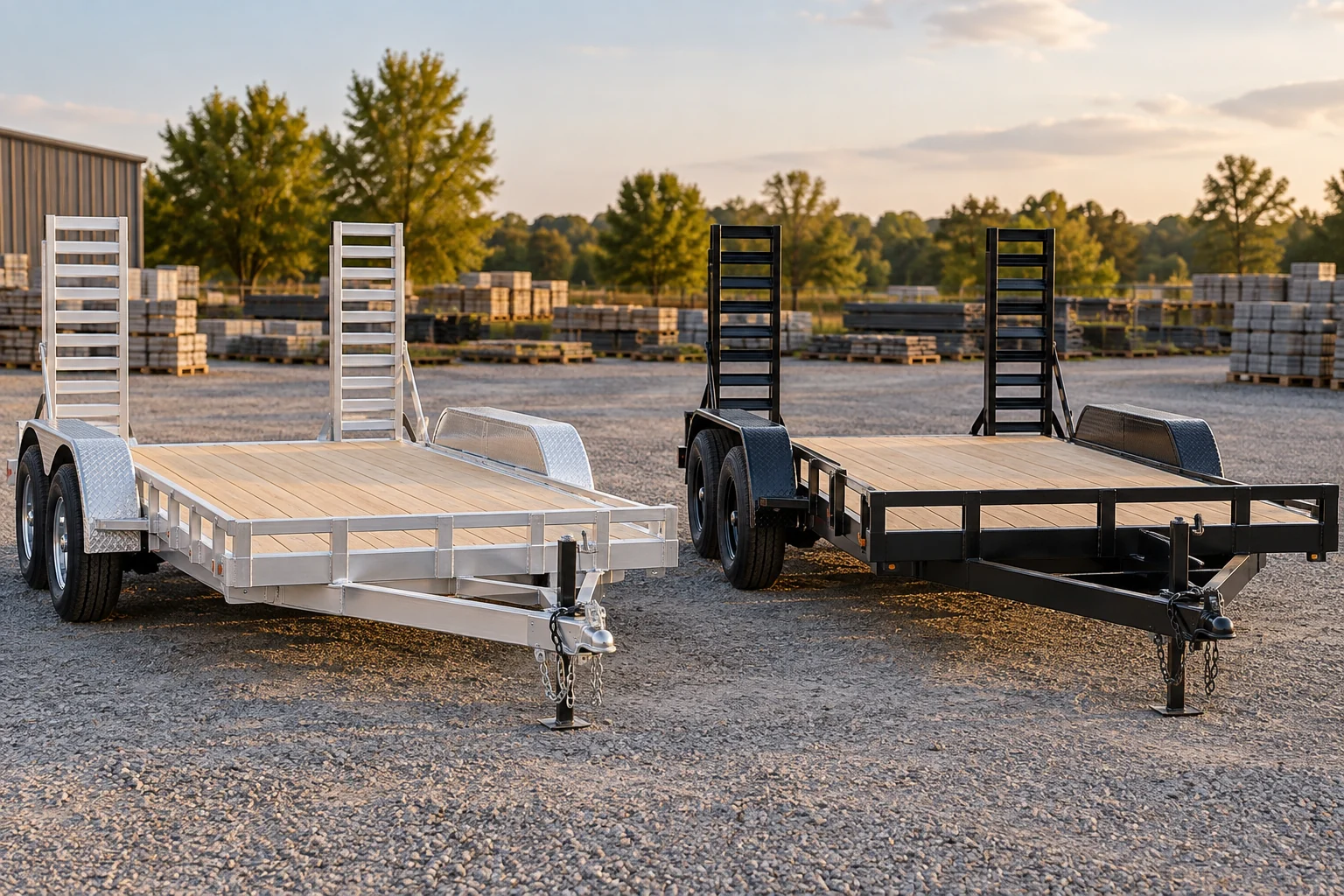
Choose between aluminum and steel trailers by comparing complete, suitably rated configurations for the same work. The material label alone does not establish payload, durability, maintenance cost or resale value. Ask what the frame, deck, body and other components are actually made from before treating two quotes as equivalent.
Fontaine's manufacturer literature separates all-aluminum trailers from aluminum-and-steel combination models. That is a useful reminder that a trailer may use more than one material and that a broad label can hide important configuration differences. Fontaine trailer literature
This guide is a commercial purchasing framework, not structural-engineering, repair or towing advice. Have qualified specialists confirm suitability, condition and applicable transport requirements for the exact equipment.
Define what “aluminum” or “steel” means in the quote
Ask the supplier to identify the construction of the frame, deck, sides and relevant components. A trailer advertised with an aluminum body is not necessarily an all-aluminum trailer. Likewise, a steel-frame design may include other materials.
Request the exact model and option list. Compare trailers with equivalent intended work, dimensions and included equipment rather than assuming the material is the only difference.
A purchase decision can change if one proposal includes ramps, tool storage or another required feature and the other does not. Separate those differences before attributing the whole price gap to construction material.
Compare documented weight and capacity, not slogans
Ask for the actual weight and rating information for each quoted configuration, then have qualified personnel assess the complete vehicle-and-trailer combination. Do not infer usable capacity from a general statement that one material is lighter.
A lighter trailer does not automatically mean the business can carry more on every trip. The proposed load, tow vehicle, configuration and applicable requirements still need review. This article does not calculate a legal load or identify the limiting component.
Similarly, do not turn a material's general properties into a claim that every trailer made from it is stronger or lasts longer. Design, condition, use and maintenance are part of the purchase assessment.
Ask about the maintenance and repair plan
Obtain the manufacturer's care requirements and the local service options for the exact trailer. Ask who can perform qualified repairs and how warranty claims are handled.
For used equipment, arrange an appropriate condition assessment. A clean finish does not establish the condition of the structure, joints or other components. Do not assume that a material associated with corrosion resistance needs no inspection or maintenance.
If the business operates in demanding conditions, describe those conditions to the supplier and qualified reviewer. Get specific guidance for the proposed equipment rather than applying a generic internet comparison to every trailer.
Use a like-for-like purchase worksheet
| Question | Evidence to collect for both proposals |
|---|---|
| Construction | Frame, deck, body and component materials |
| Configuration | Exact model, dimensions and included options |
| Suitability | Qualified assessment for the actual loads and combination |
| Condition | Inspection findings and required work for used equipment |
| Support | Local qualified service and parts arrangements |
| Warranty | Written coverage and exclusions |
| Delivery | Transport and preparation costs |
| Future sale | Evidence behind any resale assumption, not a promise |
Ask the seller to explain each material-related benefit in terms of the actual model and your workload. A claim that may be relevant to one application should not become an automatic financial benefit in another.
Test the price premium without inventing savings
Consider a fictional comparison, not market pricing:
| Assumed acquisition item | Proposal A | Proposal B |
|---|---|---|
| Trailer | $24,000 | $30,000 |
| Required options | $4,000 | $2,000 |
| Delivery and preparation | $1,000 | $1,000 |
| Listed total | $29,000 | $33,000 |
The base-price difference is $6,000, but the comparable package difference is $4,000. The example does not assign a material to either column because actual designs and inclusions determine the figures.
If someone claims the more expensive package saves $1,000 per year, ask for the evidence and what expenses are included. Four years of that assumed saving would equal the $4,000 premium before financing, timing and other differences. That is arithmetic, not proof the saving will occur or that the purchase breaks even in four years.
Do not invent fuel savings from a weight difference without a credible assessment of the actual operation. Keep unverified benefits out of the base case.
Treat resale value as a scenario
A seller may say one material holds value better. Ask what comparable completed sales support the claim and whether those trailers match the age, condition and configuration being considered.
Do not use a current asking price as a guaranteed future resale amount. Build a conservative scenario and ask what happens if the asset sells later or for less than expected.
If the financing agreement includes a final payment, keep that obligation separate from the resale estimate. A hoped-for sale does not guarantee the cash needed at the contract's endpoint.
The right answer may be a different configuration
If neither proposal fits the business, ask whether another model or combination construction addresses the actual requirement. Material choice is one part of the equipment specification, not the entire decision.
A business may value compatibility with its existing fleet, support network or daily work more than a small theoretical advantage. Document that reasoning rather than forcing the choice into a universal winner.
Have qualified personnel review any proposed change in configuration. Do not substitute a different trailer on the assumption that the same nominal material or rating makes it equivalent.
Common comparison questions
Is aluminum always cheaper to own?
No universal conclusion follows from the material label. Compare the actual purchase, support needs, use and evidence behind operating-cost assumptions.
Is steel always the better heavy-duty choice?
Have qualified specialists assess the exact trailer and load requirements. Material alone does not establish the suitability or rating of a complete design.
Can both construction types be considered for financing?
Ask the provider about the specific equipment, seller, condition and transaction. A general equipment category is not an approval.
Finance the configuration, not the slogan
Once the complete proposals have been assessed, review Dengaro's equipment-financing requirements. If you start an enquiry, provide the exact trailer and itemized costs. Eligibility, approval and terms remain subject to provider review.