
Backhoe vs excavator: choosing equipment for your business
Compare a backhoe and excavator against your existing fleet, job sequence, attachments and transport. Build a package-level purchase decision.
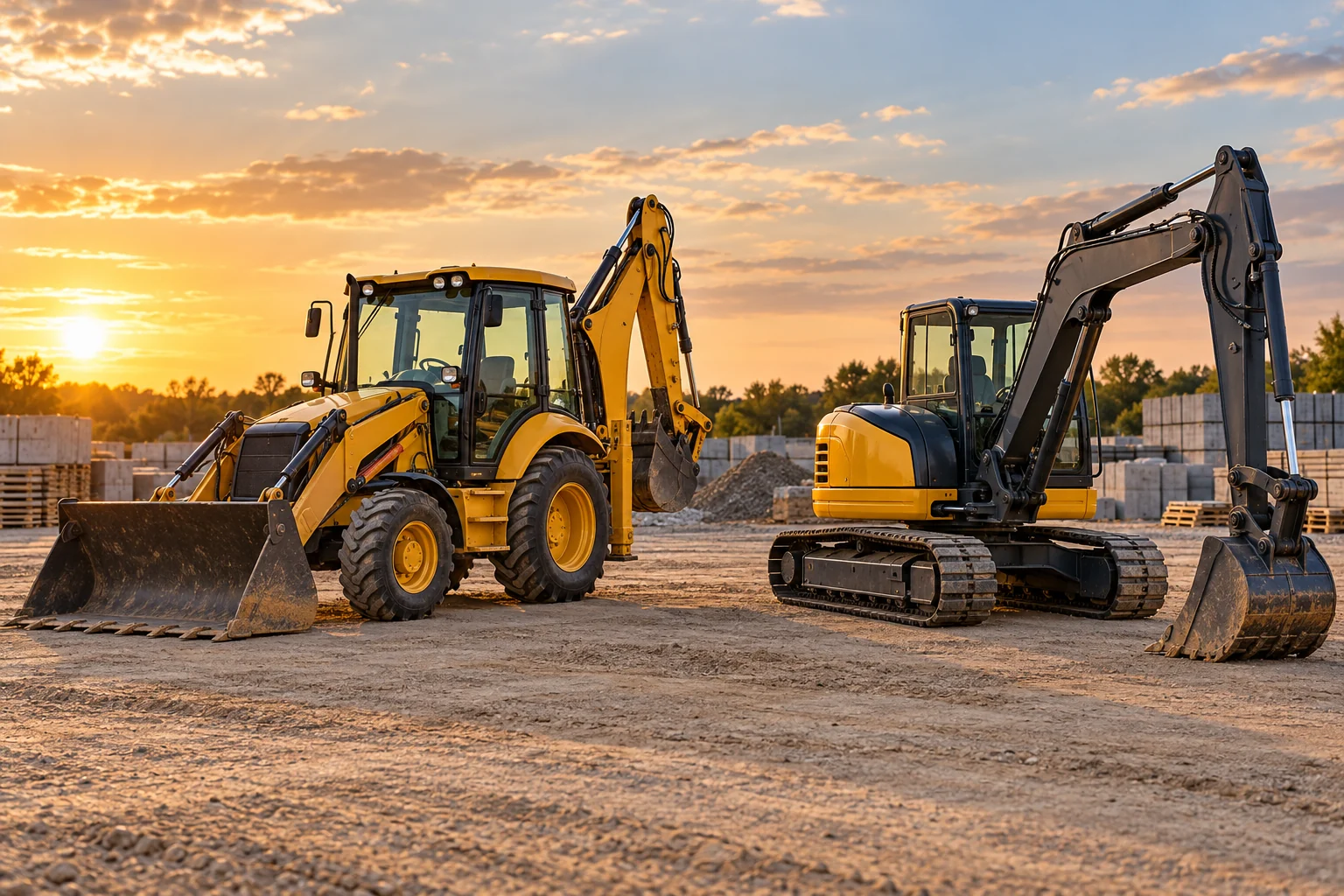
A backhoe loader is worth comparing when one machine must handle both loading and digging. An excavator is worth comparing when excavation is the main workload or the business already has a loader to handle material. The right purchase depends on the actual machine size, site access, attachments, transport and the work the rest of your fleet can do—not simply which machine can dig deeper.
This guide compares buying decisions. It is not an operating, lifting, trench-safety or transport guide. Have qualified equipment professionals confirm the machine and configuration for your work.
Compare a workload, not two category names
Write down the jobs from a representative month. Separate digging, loading, moving material and attachment work. Note where two tasks must happen at the same time rather than in sequence.
Kubota's comparison of tractor loader backhoes and compact excavators describes the backhoe loader's front-loader versatility and the compact excavator's excavation-focused role. It also discusses differences in footprint and site access. That comparison concerns particular equipment classes; it does not mean every excavator is smaller than every backhoe. Source: Kubota equipment comparison.
A compact machine suited to a narrow entrance is not automatically suited to the required digging work. Equally, buying a larger machine for an occasional demanding job can add costs to every other job. Ask the dealer to evaluate your actual mix.
Look at what the fleet already owns
The most useful comparison may not be one backhoe against one excavator. It may be a backhoe against an excavator working with an existing loader.
| Current situation | Purchase question |
|---|---|
| No loader and mixed loading/digging work | Can one backhoe perform the required tasks in the available time? |
| Suitable loader already owned | Would an excavator add the missing capability without duplicating assets? |
| Two tasks need to run together | Would one combination machine create a scheduling bottleneck? |
| Work varies widely by month | Which occasional tasks could be rented or subcontracted instead? |
| Access is frequently restricted | Which exact configurations fit, with all necessary attachments? |
These are questions to test, not answers that follow from the table alone. Consider staffing too: two machines are not automatically two productive operations if only one trained operator is available.
Request comparable demonstrations and specifications
Give each dealer the same job description. Ask for the exact machine, attachments and configuration proposed, not a general category brochure.
For each candidate, document the required reach and digging task, access dimensions, attachment compatibility, service support and transport arrangements. Ask the dealer to identify any limits that matter to the intended application. Have a qualified carrier quote transportation for the actual configuration; do not assume tires make every backhoe suitable for public-road travel between jobs.
For used equipment, compare inspected condition and records as well as hours. For new equipment, confirm what attachments and warranty coverage the quotation includes. A base machine and a work-ready package can look like very different bargains.
Build a fleet-level cost worksheet
Here is an invented example showing why the existing fleet matters. These figures are not market prices or a recommendation.
| Initial cash item | Backhoe route | Excavator route |
|---|---|---|
| Quoted machine in this example | $95,000 | $80,000 |
| Required attachments | $6,000 | $8,000 |
| Quoted transport setup | $4,000 | $7,000 |
| Initial subtotal | $105,000 | $95,000 |
If the business already owns a suitable loader, the excavator route might supply the missing capability for $10,000 less in this simplified purchase worksheet. If it also needs to acquire a loader for an invented $45,000, that route becomes $140,000, or $35,000 above the backhoe route.
Neither result proves which route is better. Two machines could perform tasks concurrently, while a single machine might fit a different workflow better. Obtain realistic task-time estimates and verify them with demonstrations where possible. Do not assign made-up hourly revenue to a machine and present the resulting payoff as certain.
Add ongoing costs separately: service, transport between sites, insurance, storage and any staffing differences. Keep the same comparison period and scope. Include financing costs only when actual offers are available, and account for any final purchase payment or return obligation.
Try the decision against a real upcoming job
Take one representative project and ask how each route would handle its sequence. Who digs? Who moves material? What happens when equipment must move to another site? Where might a second machine or rental still be needed?
Then repeat the exercise for a difficult but realistic job. The point is not to design operating procedures yourself. It is to expose purchasing assumptions for the dealer, job supervisor and qualified specialists to review.
If the business only occasionally needs a capability, compare the documented cost of renting or subcontracting that work with the cost of owning the extra equipment. Availability and scheduling matter alongside price.
Finance the chosen package, not an unresolved comparison
Once the equipment decision is supported, obtain an itemized quote and identify what the business already owns. Do not include an existing loader as a new purchase or buy extra equipment merely to reach a funding threshold.
Dengaro's equipment financing requirements can help prepare the request. Confirm the actual asset, used condition, attachments and seller with the provider; this comparison does not establish financing eligibility.
A good purchase fills a demonstrated gap in the business. Start there, and the backhoe-versus-excavator decision becomes much more useful than a contest between specification sheets.