Boom lift vs scissor lift: choosing equipment for your business
Compare boom and scissor lift purchases through qualified access review, full package cost, utilization and support responsibilities.
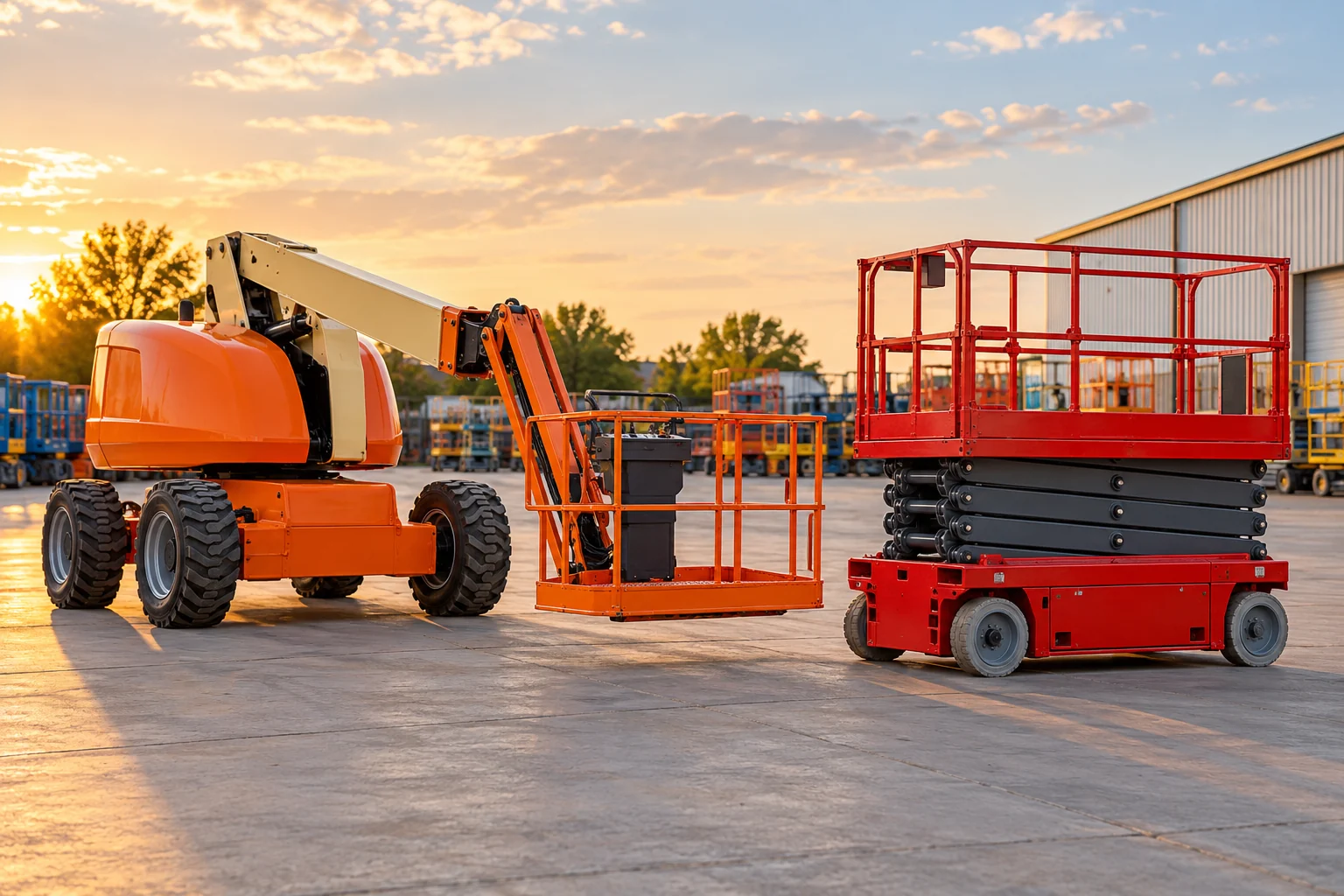
A boom lift and a scissor lift solve different access problems. Begin with where the work is located and what the qualified site assessment requires—not simply which machine has the larger advertised height or lower price. Purchase comparisons come after the appropriate equipment type and configuration are established.
JLG describes scissor lifts as primarily providing vertical access and boom lifts as offering reach through an extending or articulating arm. Its guide explains that the categories have different capabilities. Those broad differences help frame a supplier conversation but do not establish suitability for a particular worksite. JLG lift comparison
This is a commercial purchasing guide, not instructions for operating at height. Qualified personnel must assess site hazards, machine selection, training and applicable safety requirements.
Define access before comparing specifications
Ask the responsible team to document the actual work locations, obstacles, access route, surface conditions and platform requirements. Give that brief to qualified suppliers so they can assess appropriate configurations.
Do not reduce the requirement to “we need to reach a certain height.” A task may also depend on where the machine can stand, what is between the machine and the work, and what must be carried within the approved limits.
Keep occasional jobs separate from the work that will justify ownership. If one unusual task requires a very different machine, compare renting the suitable unit for that task rather than assuming one purchase must cover every possibility.
Ask for a written suitability review
For each proposal, request confirmation against the approved work brief. Avoid comparing capacity or height numbers without understanding what the manufacturer measures and the conditions attached to those ratings.
| Buying question | Detail to resolve with qualified specialists |
|---|---|
| Access path | Whether the exact configuration reaches the approved work locations |
| Platform needs | Required people, tools and materials within applicable limits |
| Site conditions | Suitability for the assessed environment and surfaces |
| Power system | The appropriate configuration and supporting infrastructure |
| Transport | How the equipment will move between sites |
| Storage | Space, security and any required charging arrangements |
| Training and support | Required preparation and ongoing service coverage |
| Inspection | Documentation and qualified assessment before acceptance |
The purpose is to make the quotation complete, not to substitute a checklist for a professional site assessment. Do not assume that choosing a broader category automatically clears a machine for indoor, outdoor or rough-terrain use.
Compare complete acquisition packages
A machine quote may exclude delivery, charging equipment, required accessories, training or the transport arrangement your business needs. Ask the supplier to list what is included and what your business must provide.
For a fictional cost comparison, assume Proposal A has a $42,000 equipment price plus $3,000 of delivery and supporting items, totaling $45,000. Proposal B has a $38,000 equipment price but needs $9,000 of additional supporting items, totaling $47,000.
The lower equipment price is not the lower package cost in this example. These amounts are invented and are not boom- or scissor-lift market prices. Both proposals would first need to pass the qualified suitability review.
Keep facility changes and recurring expenses separate from the machine subtotal. If a finance provider considers only the base equipment, ask how the additional costs will be covered before committing to delivery.
Ownership makes most sense against a real workload
Review how often the appropriate machine will be needed and for how long. Distinguish work already scheduled from jobs you hope to win. The utilization forecast should match the actual machine type, not every project involving work at height.
Suppose a fictional annual fixed ownership allocation is $12,000. At 120 days of use, that is $100 per day; at 40 days, it is $300 per day before labor, energy, transport and other variable costs.
This is an arithmetic illustration, not a rental comparison or a recommended price. Obtain actual rental quotes for the same suitable configuration and include delivery, collection, term limits and other conditions. A low daily rental rate alone is no more complete than a low machine purchase price.
If your jobs require several different configurations, owning one does not remove the need to budget rentals for the others. That distinction can prevent a promising purchase from being credited with savings it cannot actually deliver.
Compare downtime responsibilities
Ask who provides service at each intended location and what the contract includes. Establish how inspections, planned maintenance and unexpected repairs will be handled by qualified personnel.
If a supplier offers replacement equipment during repairs, ask for the written conditions and availability limits. Do not treat a general support promise as a guarantee that a suitable replacement will always arrive immediately.
Consider how a delay would affect scheduled work. You do not need to invent a revenue-loss estimate; start by identifying the jobs that depend on the asset and the practical alternatives available.
A used lift needs an asset-specific review
Collect the serial number, model, configuration, operating-hour information, service records and inspection documentation. Have qualified specialists assess condition and suitability for the intended use.
Confirm what is included with the sale and what must be repaired, replaced or supplied before acceptance. Ask about manufacturer support and replacement parts for the exact unit. A used machine's advertised height does not tell you its condition or the total cost of making an appropriate purchase.
Compare the resulting package with a new or rental alternative on the same basis. Do not equate an online asking price with a verified available unit or a completed inspection.
Questions to answer before ordering
Should I always buy the machine with more reach?
No. Qualified personnel should select a suitable configuration for the actual task and site. Additional advertised capability does not automatically create a better business purchase.
Can a scissor lift replace a boom lift?
Only if a qualified assessment establishes that the particular machine meets the actual access requirement. The two categories should not be treated as interchangeable from a price comparison alone.
Can the machine and supporting equipment be financed together?
Ask the provider to review the itemized transaction. Eligible assets, costs, seller and condition can vary, and no purchase example establishes approval.
Use the approved specification in the financing request
Review Dengaro's equipment-financing requirements after obtaining a suitable configuration and written quote. If you start an enquiry, include supporting costs separately so the provider can clarify what may be considered. Approval and terms remain subject to review.