
Bulldozer vs excavator: choosing equipment for your business
Compare bulldozers and excavators by project tasks, bottlenecks and outside-equipment needs before choosing which machine your business should own.
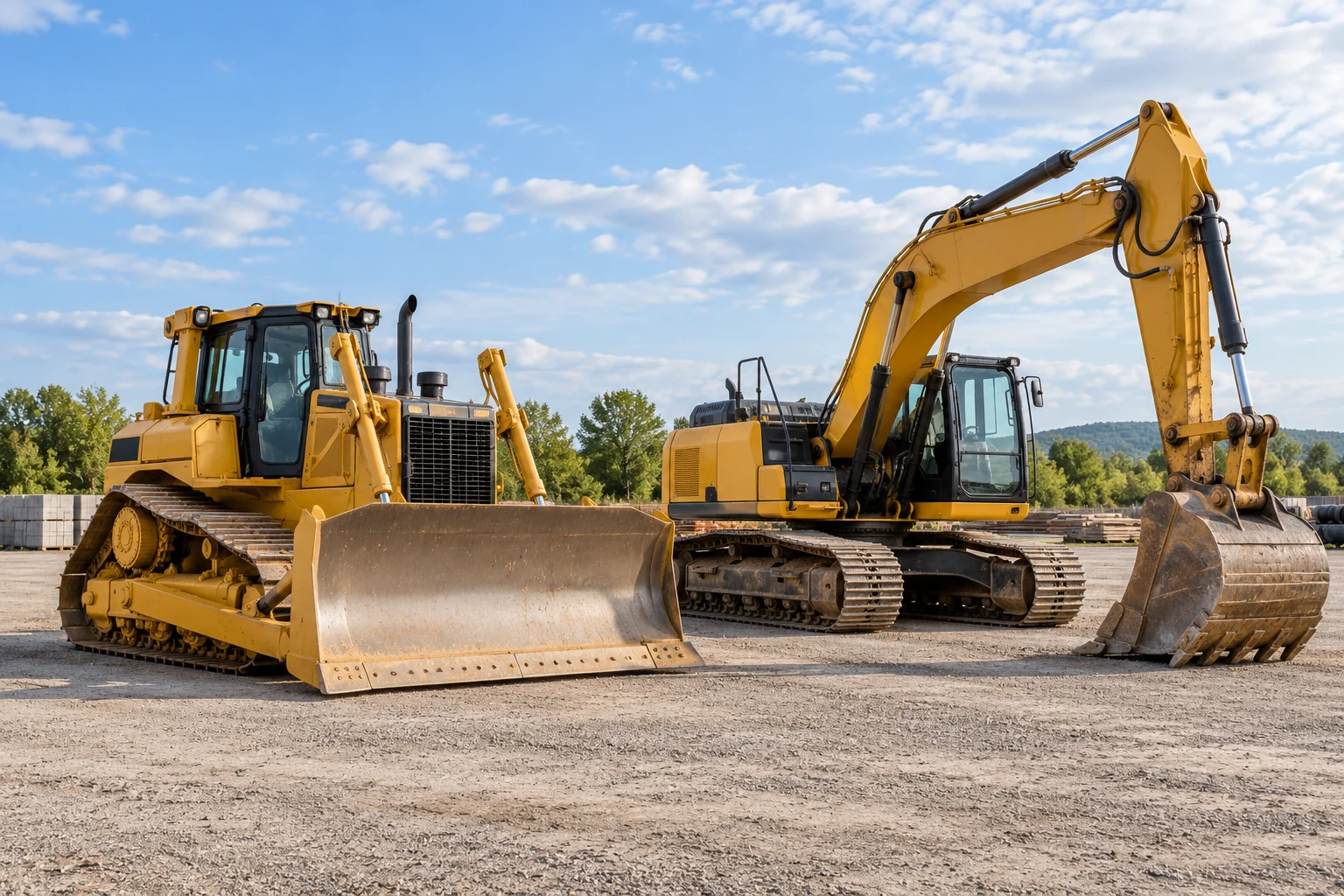
Choose between a bulldozer and an excavator by identifying the work that is holding up your projects. A dozer is a candidate for repeated pushing, spreading and grading work. An excavator is a candidate where digging, reach and bucket-based work are central. Neither category is a universal substitute for the other, and the correct model depends on professional assessment of the specific job.
For a purchase decision, the useful question is not “Which machine is stronger?” It is “Which capability do we need to own, and how will we cover the other work?” A cheaper machine can be the more expensive choice if it leaves your main task outsourced or waiting.
Separate the work into deliverables
Caterpillar’s dozer selection guide starts with application and distinguishes different kinds of dozing work. Its excavator sizing guide asks buyers to consider job requirements including digging depth, reach and bucket capacity. Those are different selection questions—not interchangeable horsepower comparisons. (Cat dozer selection, Cat excavator sizing.)
Before shopping, break your upcoming work into deliverables:
| Business requirement | Purchasing question | Evidence to bring to an equipment specialist |
|---|---|---|
| Repeated spreading or shaping work | Would a suitable dozer address the main workload? | Scope of work, site constraints and completion requirements |
| Excavation-focused work | Which excavator configuration meets the task? | Required work envelope and application details |
| Mixed earthmoving project | Which task sets the pace for the project? | Sequence, expected duration and dependencies |
| Jobs with both tasks happening together | Do we need two separate resources? | A calendar showing overlapping assignments |
| Occasional specialist work | Is outside equipment a better fit for that portion? | Rental or subcontract scope and availability |
Use this as a buying conversation, not operating guidance. It does not establish safe reach, lifting capacity, ground suitability or methods for any machine.
Find the bottleneck instead of counting possible uses
A seller may describe many things a machine can do. Your business needs to know which of those tasks recur often enough to justify ownership.
Review a sample of completed jobs. Where did your crew wait for equipment? Which outside service created a scheduling problem? Which machine was available but not useful for the work that needed doing?
Then review upcoming jobs separately. Label the work as contracted, likely or speculative. A dozer that suits a possible large grading project should not be compared with an excavator supported by a full year of confirmed work as though both forecasts have equal certainty.
A practical shortlist might read:
- Own the machine that serves the recurring core task.
- Obtain written outside-equipment quotes for the remaining task.
- Reconsider a second purchase only when the work record supports it.
That is a planning method, not a guarantee that owning either machine will save money.
Compare complete ways to deliver the same project
Do not compare the two purchase prices in isolation. Compare the total scope needed to complete the same work.
In this fictional example, a business is considering two suitable equipment plans:
| Planning item | Buy dozer; source excavation separately | Buy excavator; source dozing separately |
|---|---|---|
| Purchase and agreed delivery | $150,000 | $165,000 |
| Quoted outside-equipment work for the defined projects | $24,000 | $9,000 |
| Limited first-project-set cash outlay | $174,000 | $174,000 |
This is not a cost-of-ownership analysis: it combines an asset purchase with spending for a defined project set. It excludes financing, resale value, taxes, operating expenses and other costs. The amounts are invented, not market quotes.
Its purpose is narrower. The $15,000 difference in purchase price disappears when the missing capability is included. Your actual analysis needs written quotes and a consistent time period, plus an ownership budget prepared for your business.
Timing can change the answer even when totals match
Two equal totals may create different schedules. If excavation must be complete before the next phase can start, delayed outside equipment can affect more than its own work period. The same applies to grading or spreading work that other crews depend on.
Ask the outside provider about availability, mobilization and what happens if the dates change. Record those answers beside the equipment quotes. Do not assume a rental unit or subcontract crew will be available simply because you obtained a price.
Where tasks overlap, identify which resource does each job. One machine cannot be assigned to two places at once, regardless of how many attachments it supports.
Request specifications only after the role is clear
Once the business role is chosen, have a qualified dealer or equipment specialist recommend the exact configuration. For a dozer, that means the appropriate machine and blade package for the intended work. For an excavator, it means the relevant working configuration and attachments—not just a model number from a listing.
Ask for a written quote with included equipment, condition records for used units, delivery and any required seller work. Avoid assuming that attachments shown in photos transfer with the purchase.
Connect the choice to the purchase file
Dengaro’s equipment financing requirements can help organize the business and equipment information once you have a suitable proposal. Confirm the specific machine, seller and transaction are eligible before relying on funding. A purchasing comparison does not establish approval or terms.
Can an excavator replace a bulldozer?
Not as a blanket rule. Ask whether the proposed configuration meets the actual task, quality requirement and schedule. A list of possible uses is not proof that two machines are equivalent.
Which should a small contractor buy first?
Start with the recurring, documented work that is hardest to cover reliably. Compare ownership plus the cost and availability of the missing capability. That gives you a business decision instead of a contest between machine names.