
Commercial laundry equipment leases: ownership and service obligations
Compare commercial laundry equipment leases with managed-room arrangements, including service duties, revenue terms and end-of-term responsibilities.
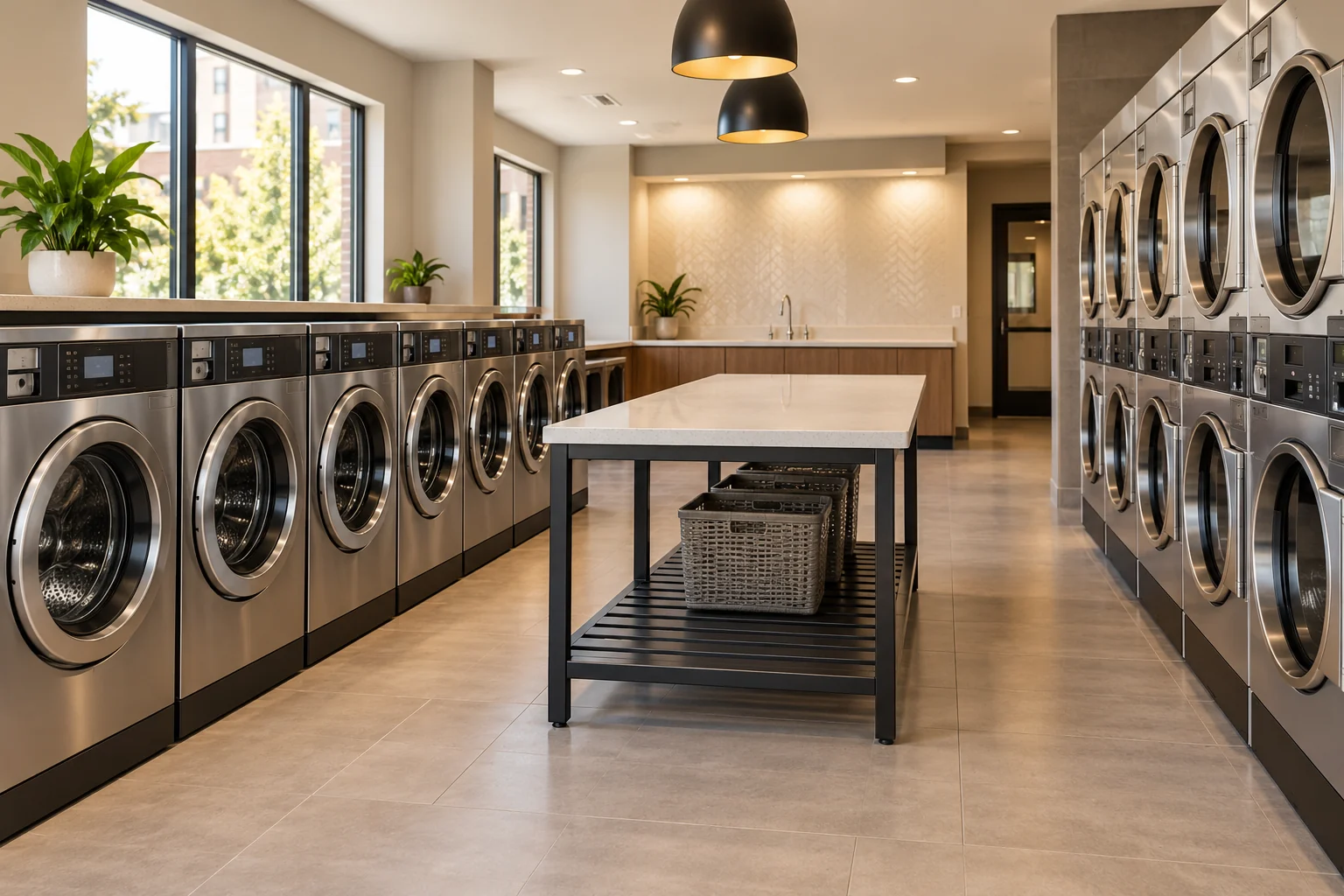
For a hotel or multifamily property, a laundry equipment lease and a full-service laundry-room arrangement are not necessarily the same thing. One may finance machines your team operates; another may combine equipment, maintenance, payment systems and room management. Compare who owns the machines, who does the work and how money moves before comparing monthly figures.
This guide covers on-premises and residential-property laundry. Buying a laundromat business involves a different acquisition analysis, including the business itself, and is outside this scope.
Decide which problem you want the agreement to solve
A hotel replacing worn machines may mainly need equipment and reliable service. A property manager may want someone else to handle resident payments, refunds, service calls and reporting. Those are different requests.
CSC ServiceWorks describes several models, including equipment purchase, leasing, service agreements and community-laundry management or revenue-sharing arrangements. WASH describes a full-service model in which it leases the laundry room and provides equipment and management services. These are examples of provider offerings, not standard terms or recommendations for your property. CSC laundry solutions, WASH full-service laundry.
Start with a sentence such as: “We want to retain operation of our hotel laundry but replace four machines,” or “We want a managed resident laundry room with clear reporting and service responsibilities.” Give every bidder the same request.
Build a responsibility map
Instead of accepting “full service” as a complete answer, ask who is responsible for each function in the proposed arrangement.
| Function | Questions to settle |
|---|---|
| Equipment ownership | Who owns each machine during and after the term? |
| Selection and installation | Who confirms suitability, completes installation and accepts the work? |
| Routine care | Which tasks remain with property staff? |
| Repairs | Who reports faults, authorizes work and pays excluded charges? |
| Payment collection | Who sets prices, collects funds and handles refunds? |
| Reporting | What records can the property access and retain? |
| Utilities and premises | Which costs and property obligations remain outside the package? |
| Replacement | What triggers repair versus replacement, and who decides? |
For an on-premises hotel laundry, revenue sharing may not be the relevant model because the machines support the hotel operation rather than collect resident payments. Ask for a proposal appropriate to that use; do not borrow the economics from a coin-operated room.
Have qualified installers assess the site and equipment. This is a commercial comparison, not guidance on electrical, plumbing, venting or operating requirements.
Turn a service promise into a measurable question
A service number is helpful, but it does not tell you the whole response process. Ask when a fault is acknowledged, how urgency is determined, what coverage exists outside normal hours and what happens if parts are unavailable.
Record the actual written commitment separately from a sales estimate. “We usually respond quickly” is not the same as a defined obligation. Ask which charges are excluded and what documentation confirms completed work.
For a hotel, consider how laundry continues during a prolonged outage. For a multifamily room, ask who communicates with residents and handles refunds. You do not need to predict every failure; you need to know who owns the response.
A provider's portal may help with visibility. CSC, for example, describes access to usage, revenue, service and refund information through its customer systems. Confirm which reports the proposed package actually includes and whether you can export them. Source: CSC customer portals.
Compare cash flows without mixing business models
Here is an illustrative comparison, using invented monthly amounts. It is not a supplier quote, profit forecast or recommendation.
Suppose a property is comparing self-operation with a managed-room proposal. Assume identical gross resident collections of $3,000 solely for the exercise.
| Assumed monthly line | Self-operated equipment lease | Managed-room arrangement |
|---|---|---|
| Gross collections used in the illustration | $3,000 | $3,000 |
| Equipment payment | $900 | Included in assumed provider arrangement |
| Separately budgeted service | $200 | Included in assumed provider arrangement |
| Property's assumed share before its own expenses | $1,900 | 55% × $3,000 = $1,650 |
The apparent $250 difference does not establish that self-operation is more profitable. Staff time, payment processing, utilities, refunds, downtime, taxes and other costs have not been included. The managed proposal may also define the revenue-share base differently from gross collections.
Ask whether the percentage applies before or after deductions, which deductions are allowed and how they appear on statements. Then replace every assumption with the actual proposal. Do not compare a net payment from one bidder with gross collections from another.
Read the exit plan while choosing the machines
For an equipment lease, ask whether purchase, return or renewal is available and how the price and notice requirements are determined. For a managed room, ask what happens to the equipment, payment system and resident balances when the arrangement ends.
If your property may be sold or renovated, ask how that event is handled. Do not assume an agreement can be canceled or transferred simply because the ownership or building plans change. A qualified adviser should review contractual questions; this article does not interpret your rights.
Also ask who removes equipment, restores affected areas and coordinates a replacement provider. Keep those responsibilities visible even if the end date seems far away.
Prepare the equipment request separately from management services
If you intend to buy or finance machines rather than enter a managed-room arrangement, request an itemized equipment quote. Include model, quantity, condition, installation scope and service terms. Separate premises work and ongoing operating expenses.
For a possible Dengaro request, begin with the equipment financing requirements. Confirm support for the actual machines, use, vendor and transaction. Dengaro's equipment information should not be read as an offer to manage a laundry room or guarantee a lease structure.
Questions worth resolving first
Does leasing mean maintenance is included?
Not necessarily. Obtain the service scope and exclusions for the specific proposal. Financing equipment and maintaining it are separate responsibilities unless the agreement combines them.
Is revenue sharing always better than a fixed equipment payment?
No single answer fits every property. Compare the same usage assumptions, all property expenses, operating responsibilities and exit terms. Avoid treating an illustrative collection estimate as guaranteed income.
What should we ask bidders to submit?
A machine list, responsibility map, service process, complete cash-flow terms, reporting sample and end-of-term explanation. Those documents make the comparison clearer than a payment or percentage alone.