
Dry ice blasting machine price: a commercial buyer’s budget guide
Review a manufacturer dry ice blaster price reference, then budget supporting air equipment, accessories, supply and commercial utilization.
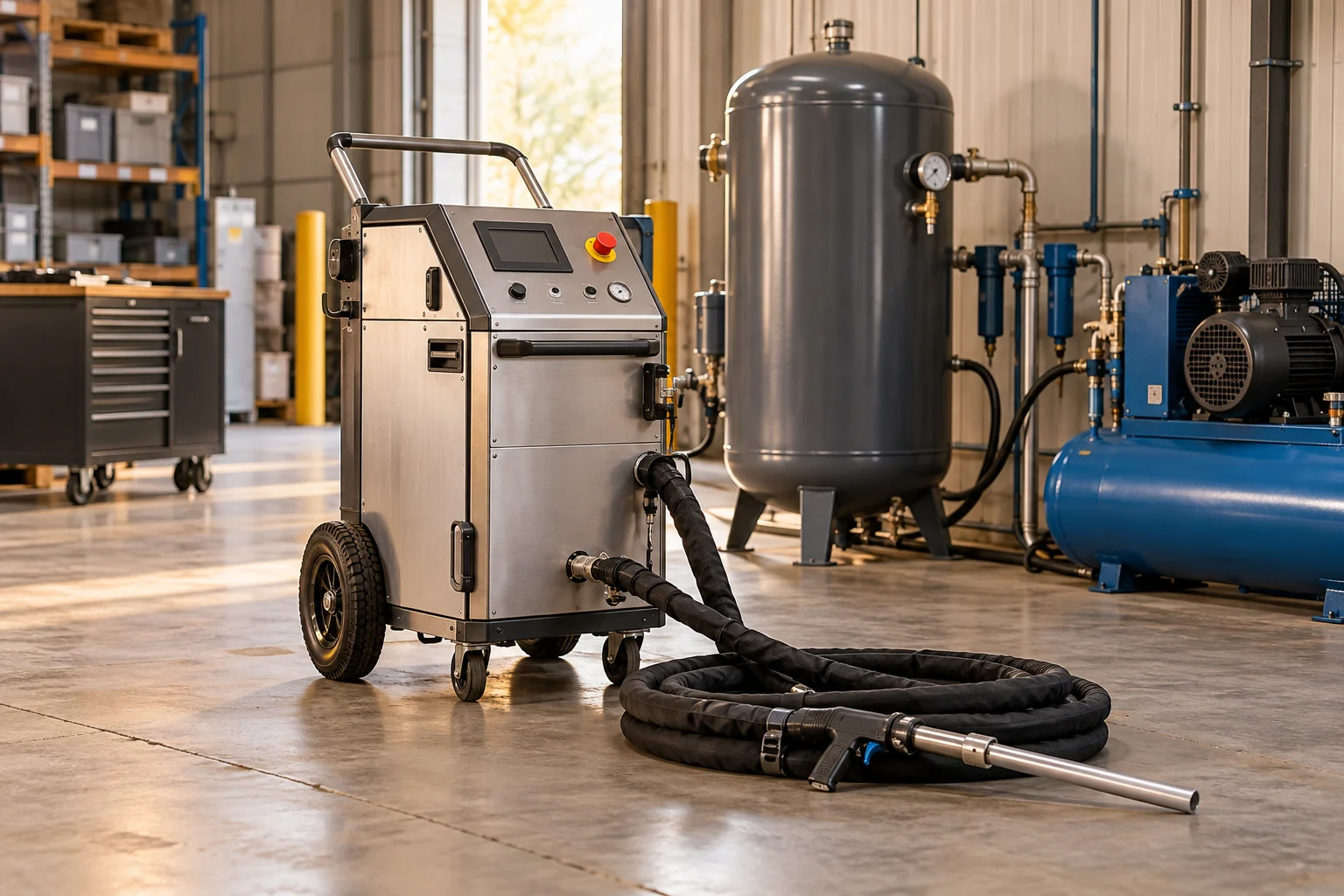
Cold Jet's manufacturer guide lists professional-grade dry ice blasters at $15,000 to $55,000, as reviewed on October 30, 2026. Treat that as the manufacturer's published planning reference—not a verified price for every brand, a dealer offer or the cost of a complete installed cleaning system. Obtain a current quote for the machine and support equipment your application requires. Cold Jet buying guide
The larger purchasing question is what you need around the blaster. An attractive machine price can become a poor comparison if one proposal includes air-supply equipment, accessories and training while another leaves those responsibilities with you.
This article addresses equipment acquisition, not how to perform blasting or assess a hazardous worksite. Qualified safety and technical specialists must determine suitability and operating requirements before purchase or use.
Separate machine price from a cleaning-service quote
A contractor's price for cleaning a particular asset is not the price to buy the equipment. Similarly, a used listing may be for a machine alone rather than the working package shown in its photographs.
Identify which transaction you are comparing:
- A new blaster with a defined accessory package.
- A used machine whose condition and support need verification.
- A machine plus supporting equipment for a specific facility.
- A rental or outside service for a limited workload.
Keeping those categories apart prevents a low entry figure from becoming the budget for a much larger project. Do not add unrelated equipment solely to reach a finance provider's minimum transaction size.
Ask what supports the proposed machine
Cold Jet identifies the blaster, air compressor, suitable air treatment and dry ice supply among the elements involved in setting up a system. Its guide also notes that machine choice depends on the application and air supply. Those are scope questions for a supplier—not specifications to guess from a price list. Cold Jet system guide
Ask the vendor to assess the equipment already available at your site and state in writing what can be used with the proposed package. An existing compressor should not be counted as suitable merely because the business owns one.
If the purchase is intended for work at multiple customer sites, identify which supporting assets travel with the machine and which must be available at each location. Leave technical and safety requirements to qualified professionals; the purchasing job is to make responsibility and cost visible.
Put the same scope in every request for quotation
| Budget line | Question to resolve |
|---|---|
| Blasting machine | Which exact model and condition are quoted? |
| Accessories | Which hoses, nozzles and other required items are included? |
| Air supply and treatment | What additional equipment is required for the agreed application? |
| Delivery and handover | What freight, setup and training charges remain? |
| Service | What is covered, for how long and by whom? |
| Consumable supply | What current local supply arrangement is available? |
| Site requirements | What must qualified specialists assess and budget separately? |
| Acceptance | What evidence establishes that the package meets the purchase brief? |
A manufacturer's feature list is not your acceptance plan. Ask for a representative demonstration or other agreed evidence, evaluated by qualified people against your requirements. Do not extrapolate one successful demonstration to every surface or contaminant you may encounter.
Build a complete acquisition total
Here is a fictional budget, not a supplier quotation or a statement that these amounts will buy a suitable system.
| Assumed item | Amount |
|---|---|
| Defined blaster package | $30,000 |
| Supporting air equipment | $12,000 |
| Additional accessories | $3,000 |
| Freight and training | $2,000 |
| Initial purchase total | $47,000 |
If a financing proposal includes the first three equipment lines but excludes freight and training, the proposed financed amount is $45,000 and the business has a $2,000 gap. Actual providers may treat costs differently, so ask for a line-by-line eligibility decision.
Do not mistake this purchase total for a first-year operating budget. Consumables, labor, transportation, maintenance and site-specific requirements belong in a separate operating forecast. Both totals matter, but they answer different questions.
Verify the supply assumption before projecting savings
Ask for a current local supply quote and delivery terms for the form of dry ice the supplier specifies. Record minimum purchases, delivery frequency and the costs relevant to your planned workload. Do not build a business case around an internet price from another region.
Have qualified staff estimate usable supply and operating requirements for representative jobs. A low quoted consumable unit price does not establish the cost of completing a customer's work. Nor does a machine's maximum output prove that every job can be completed at that rate.
Be especially cautious with guaranteed savings claims. Compare the entire agreed task and its preparation, labor, interruptions and follow-up work—not just the time the machine is active.
Test utilization with a simple ownership worksheet
Suppose an invented comparison assigns $18,000 per year of fixed ownership costs to the equipment. At 300 productive hours, that allocation is $60 per hour. At 150 hours, it is $120 per hour before labor, consumables and other variable costs.
These figures do not estimate market costs or tell you what to charge. They show why the amount of work you can reliably secure matters. Keep committed internal use separate from hoped-for customer jobs.
Compare the full ownership case with actual rental or service proposals for the same workload. Check who supplies supporting equipment and who bears transport and downtime costs. A lower daily rental figure may describe a narrower package than the one your ownership budget includes.
Used equipment needs more than a demonstration video
Request the serial number, service history, included accessories, written condition report and the seller's terms. Ask the manufacturer or qualified service provider what support remains available for that unit.
Confirm what is missing from the package before comparing it with new equipment. If essential accessories, supporting equipment or training must be purchased separately, include them. Do not interpret an online asking price as evidence of stock availability, condition or delivery timing.
Questions buyers often miss
Does the published machine range include installation?
The cited manufacturer reference is not an itemized project quote. Obtain written inclusions and exclusions for your specific purchase rather than assuming supporting equipment or site work is covered.
Can a lower-cost machine do the same work?
Have qualified specialists evaluate the actual configuration against the agreed application. Price alone does not establish equivalent capability, support or safe suitability.
Is specialty cleaning equipment eligible for financing?
The provider must review the asset, seller, condition, business and transaction. Neither a supplier price nor this guide establishes approval.
Start with the itemized purchase
Review Dengaro's equipment-financing requirements once you have a defined package. If you start an enquiry, ask which equipment and associated costs can be considered. Eligibility, approval and terms remain subject to provider review.