
Egg grading machine price: a commercial buyer’s budget guide
Build an egg grading equipment budget around packing mix, usable capacity, detection modules and installation instead of an unsupported price range.
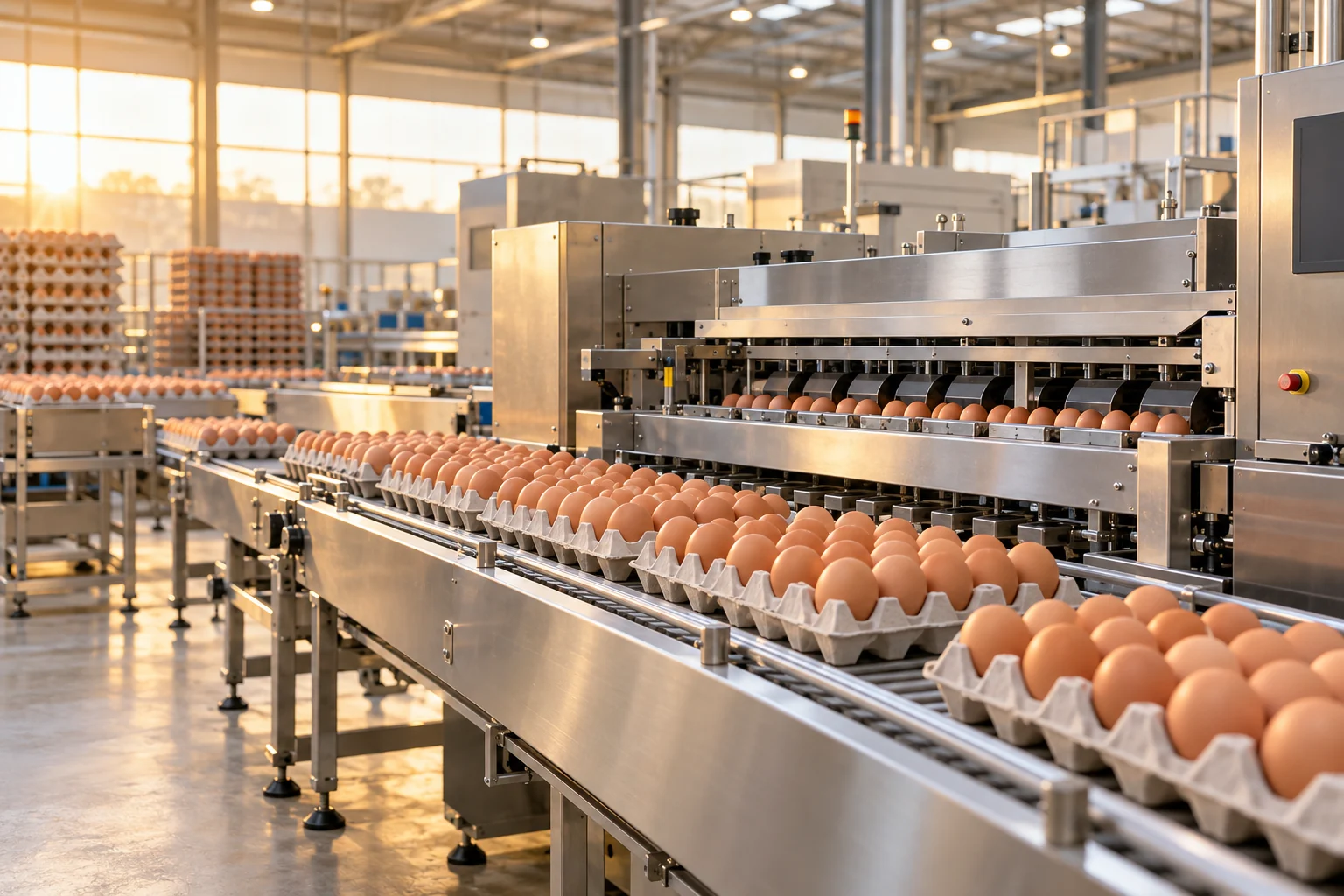
An egg grading machine price is useful only when it identifies the capacity, inspection scope, packing arrangement and line integration being purchased. A small standalone grader and a large grading-and-packing installation are not comparable price references. Ask for a written quote tied to your actual production and packaging needs.
The manufacturer page reviewed for this guide on October 30, 2026 provided configurations rather than a public purchase price. We do not replace that missing quote with an invented industry range. Instead, the worksheet below separates the grader from the other purchases that may be needed to make it useful.
This is a commercial purchasing guide, not food-safety, egg-handling or equipment-operation advice. Qualified specialists must establish product requirements, facility suitability and applicable compliance obligations.
What exactly are you buying?
Moba's Omnia ET page describes grading and packing by weight and/or defects, with several rated capacities and different packing-lane arrangements. It lists 45,000 eggs per hour for the ET125 and 180,000 for the ET500, illustrating why a shared product-family name does not establish equivalent scope or price. These are manufacturer ratings, not guaranteed output for your facility. Moba Omnia ET
Ask the supplier to mark the quoted equipment on a layout. Identify where eggs enter, what the machine is expected to check and where each output goes. Then distinguish equipment supplied by the vendor from existing equipment your business must provide.
Do not assume that grading includes every detection, packing or handling feature shown in a video. The quotation should name the included modules and the tasks that remain outside the package.
Start with the packing mix, not the largest capacity
Prepare a list of the pack formats and product streams your business actually needs. A single headline throughput cannot show whether a proposed configuration handles that mix well.
Record your ordinary daily demand, peak demand and available production hours. Separate committed volume from a hoped-for new customer. Ask the supplier to explain the capacity available for the agreed mix, including the effect of planned changes between formats.
For example, a business may have enough nominal grading capacity but lack packing capacity for one heavily used format. Buying a larger grader alone would not answer that purchasing problem. A different business may need to remove a manual transfer step rather than increase the machine's headline rating.
The purpose is not to design the line yourself. It is to give qualified suppliers a clear brief and make their proposals comparable.
Use a scope checklist for each quotation
| Purchase item | Written detail to request |
|---|---|
| Main grader | Model, configuration and rated capacity basis |
| Infeed and handling | Included equipment and interfaces to existing assets |
| Detection features | Exact modules included and acceptance criteria |
| Packing equipment | Formats, lanes and required change parts |
| Controls and data | Included reporting, licenses and interfaces |
| Facility integration | Supplier work versus buyer responsibilities |
| Delivery and commissioning | Freight, installation, training and acceptance scope |
| Support | Service coverage, parts availability and response arrangements |
Avoid a quotation that simply says “complete system” without defining the boundary. Ask who is responsible when equipment from two suppliers must work together and which party verifies the complete agreed configuration.
Have your qualified team review the layout and utility requirements before signing. A price that excludes necessary facility changes is not a complete acquisition budget.
A fictional package illustrates the funding gap
The following amounts are invented purchasing assumptions, not egg-grader market prices or a quote for a Moba product.
| Assumed purchase component | Amount |
|---|---|
| Grading equipment | $90,000 |
| Infeed and packing equipment | $35,000 |
| Controls and integration | $12,000 |
| Delivery, installation and training | $8,000 |
| Initial acquisition total | $145,000 |
If a proposed financing arrangement includes only the $125,000 of grading, infeed and packing equipment, the business still needs $20,000 for the other lines. Ask the provider to specify eligible costs rather than assuming that every item on a project budget can be financed.
Keep ongoing labor, packaging supplies, utilities, maintenance and other operating expenses outside this initial purchase table. They still matter to the business case, but mixing them into a machine price makes competing equipment quotes harder to compare.
Test capacity against useful output
Suppose a fictional planning case requires 240,000 eggs to pass through the agreed workflow in six available production hours. The simple average is 40,000 per hour. If only five hours are available, the same demand requires 48,000 per hour.
That calculation is a demand worksheet, not proof that a machine rated at either figure will meet the plan. Supplier and facility specialists must account for the actual product mix, handling, packing and interruptions. Do not treat a brochure maximum as sustained accepted output.
Request a written acceptance plan defining the configuration, representative workload and measures your qualified team will use. Have the supplier state what happens if the agreed test is not met. This creates a purchase checkpoint without turning a buying article into an operating manual.
Compare replacement and expansion separately
A replacement project should identify which existing components can genuinely remain. Obtain confirmation of compatibility and condition rather than assuming that a similar model will connect without extra work.
An expansion project needs its own scope. Additional production may require changes outside the grader itself. Ask whether the proposal addresses the actual bottleneck or merely adds nominal machine capacity.
For used equipment, request the serial number, configuration, included modules, service records and qualified inspection. Confirm support and replacement-part arrangements before treating a lower asking price as a lower project cost. Missing modules and relocation work belong in the comparison.
Common buying questions
Why do suppliers ask for so much detail before pricing?
Capacity, packing configuration, detection scope and integration can describe very different purchases. A detailed brief helps the vendor quote the system you need rather than a base machine with unknown extras.
Is the lowest machine price the cheapest project?
Not necessarily. Compare the same completed scope, including integration, commissioning and the support you require. A lower base price may leave more work for another supplier or your business.
Should seasonal demand drive the whole purchase?
Show the supplier both the normal and peak workloads. Compare the cost of meeting the peak with alternatives your qualified team considers workable. Do not assume year-round utilization simply to justify a larger installation.
Take a defined package to the provider
After you have an itemized quotation, review Dengaro's equipment-financing requirements. If you start an enquiry, ask whether the specific agricultural processing equipment, seller and project costs fit available options. Approval, eligible amounts and terms require provider review.