
Fiber laser vs CO2 laser: choosing equipment for your business
Compare commercial fiber and CO2 laser systems by workload, accepted parts, complete installation cost and support—not just source type or machine price.
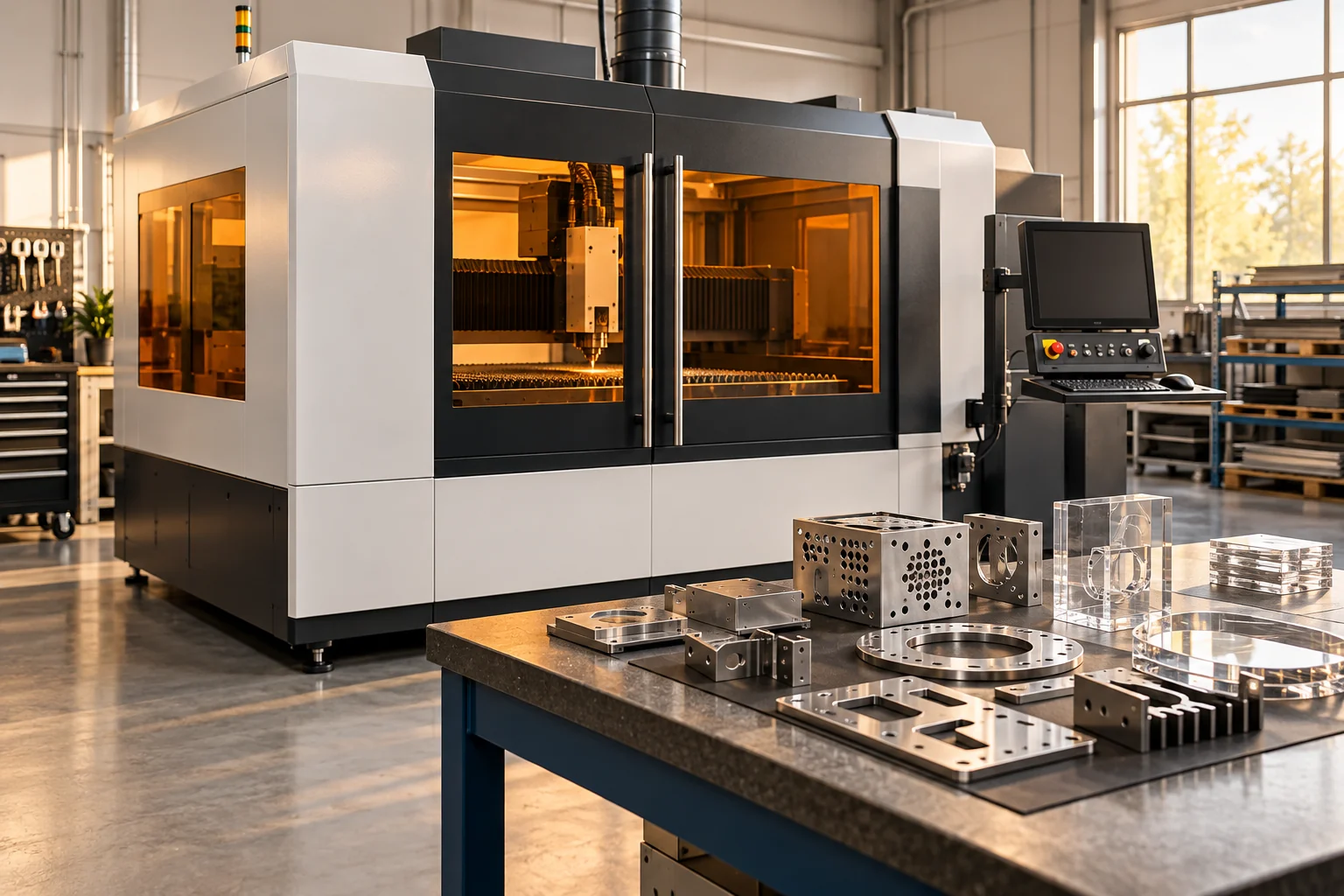
The right choice depends on the work you need to sell, not which laser sounds newer. A commercial sheet-metal cutting system, a part-marking workstation and a sign-making engraver are different purchases. Start by defining the material, finished result and production volume. Then compare complete systems that can do that same job.
For a shop buying equipment, the useful question is: Which quoted machine can produce our accepted parts, at our required volume, with costs we can support? The laser source is one part of that answer.
First separate cutting from marking
A fiber marking machine is not automatically a sheet-metal cutter. And a CO2 engraving system should not be compared with an industrial metal-cutting installation just because both have a laser inside.
Trotec's manufacturer guide describes CO2 systems for cutting and engraving materials such as wood and acrylic, while its fiber marking systems address bare-metal marking and some plastics. Those are application categories, not permission to process an unknown material on any machine. Have the supplier confirm compatibility with your exact stock and intended result. Trotec laser-source guide
For industrial cutting, TRUMPF lists different laser sources for different applications, including fiber and CO2. Its product information covers metal and non-metal work across different systems. That is why a simple rule such as “CO2 cannot cut metal” is too broad. TRUMPF cutting applications
Keep three buying paths separate:
- Marking: adding identification or a specified surface mark to a part.
- Engraving and non-metal cutting: producing signs, panels or other approved products.
- Industrial metal cutting: producing cut parts from a defined metal stock and thickness range.
If the quotes belong to different paths, stop comparing their prices until the scope matches.
Build a workload sheet before asking for quotes
Use recent paid jobs or firm customer specifications, rather than an imagined list of everything a laser might do.
| Buying question | What to put in the request |
|---|---|
| What are we processing? | Exact material grade, finish and supplier specification |
| What result is required? | Cut part, engraved area or mark, with acceptance criteria |
| How large is the work? | Stock dimensions, part dimensions and required working area |
| How much work is there? | Typical batch, changeovers and expected monthly volume |
| What happens afterward? | Inspection, cleaning, finishing and packing steps |
| How will parts move? | Manual handling, fixtures or a proposed automation package |
| Who will run it? | Staffing plan and supplier training requirements |
Ask each vendor to explain what is included and what needs another machine or outside service. A quote that covers your main revenue-producing jobs can be more useful than one advertising a long list of possible applications.
Do not use this article as operating or safety guidance. Have the manufacturer and qualified site professionals specify guarding, extraction, utilities and safe material handling for the proposed installation. Do not improvise those systems to make a quote cheaper.
Compare finished parts, not a headline speed
For a demonstration, give shortlisted suppliers the same approved test job and acceptance criteria. Ask for a written record of the configuration used. A result produced on a different machine or with optional equipment may not represent the quote you receive.
Track the whole workflow:
- Preparation and loading.
- Processing time for the agreed batch.
- Unloading and any required finishing.
- Inspection and the number of accepted pieces.
- Changeover to the next representative job.
A faster processing step does not necessarily mean more finished orders. The next step might become the bottleneck. Nor does one attractive sample prove the system handles every material or thickness you sell.
Compare the complete installed package
Put both proposals into the same worksheet. Mark each item included, separately quoted, excluded or not applicable.
- Machine, source and quoted configuration.
- Workholding, rotary attachment or other required fixtures.
- Loading and unloading equipment.
- Software, licenses and renewal terms.
- Supplier-specified extraction and supporting equipment.
- Delivery, rigging and commissioning.
- Site preparation quoted by qualified professionals.
- Training and acceptance testing.
- Warranty, service coverage and excluded parts.
- Consumables and planned replacement items.
Ask whether software transfers with a used system and whether the supplier will support its exact model and serial number. Get those answers before paying a deposit, not after the machine arrives.
A lower machine price can become a higher project price
Consider this hypothetical example, not a market price or supplier offer:
| Item | Proposal A | Proposal B |
|---|---|---|
| Quoted machine | $90,000 | $110,000 |
| Required accessories and software | $18,000 | $7,000 |
| Delivery and commissioning | $9,000 | $5,000 |
| Separately quoted site work | $12,000 | $8,000 |
| Project subtotal | $129,000 | $130,000 |
The initial machine-price gap is $20,000. Once these assumed items are included, the project gap is $1,000. Taxes, financing charges and ongoing costs are outside this example.
That does not make either proposal the winner. It makes them ready for a useful comparison of output, support and cash needs.
Give maintenance and downtime their own questions
Avoid assuming that one source type makes the whole machine maintenance-free. Ask each supplier for the maintenance schedule and service terms for the complete system.
Who provides local service? What is covered remotely? Which parts are excluded? What happens if a component is no longer supported? What response is promised in writing, and what is merely an estimate?
For a used purchase, obtain records, a configuration list and an inspection by a qualified specialist. Budget from that actual condition report rather than treating the used price as the total investment.
A practical operating comparison also needs your own figures for labor, approved consumables, utilities, software renewals and expected workload. Do not turn a vendor's best-case demonstration into a promised monthly profit.
Match financing to the chosen package
Once the configuration is settled, separate equipment, site work and operating cash. A lender may not treat all three the same way. Ask which specific items can be financed, when vendor payments occur and which deposits must come from your business.
Review Dengaro's equipment-financing requirements, then confirm support for the exact equipment, seller, condition and transaction before relying on an offer. A general equipment-financing route is not proof that every laser system or installation expense qualifies.
Common buyer questions
Is fiber always better than CO2?
No universal answer fits every commercial workload. Compare systems designed for the same finished result and test your actual job requirements. Do not rank a marking workstation against a cutting machine as if they were substitutes.
Should we buy one machine for both metal and non-metal work?
Ask suppliers to demonstrate the precise applications you need. Separate systems or outside processing may be worth comparing if a proposed combined solution adds cost without covering your core jobs well.
What should we send with a financing enquiry?
An itemized equipment quote, configuration and condition details, seller information and a separate project-cost sheet. Keep unquoted work visible rather than hiding it inside the machine price.
Choose the workload first
A useful purchase decision ends with a defined job, an accepted sample, an itemized package and clear support terms—not simply “fiber wins” or “CO2 is cheaper.”
When those pieces are ready, you can start a Dengaro enquiry and ask whether the specific purchase fits available financing options. Approval, terms and eligible costs depend on provider review.