
Flail mower vs rotary cutter: choosing equipment for your business
Choose a flail mower or rotary cutter by the vegetation, finish and tractor combination your business actually needs—not by which attachment looks tougher in a listing.
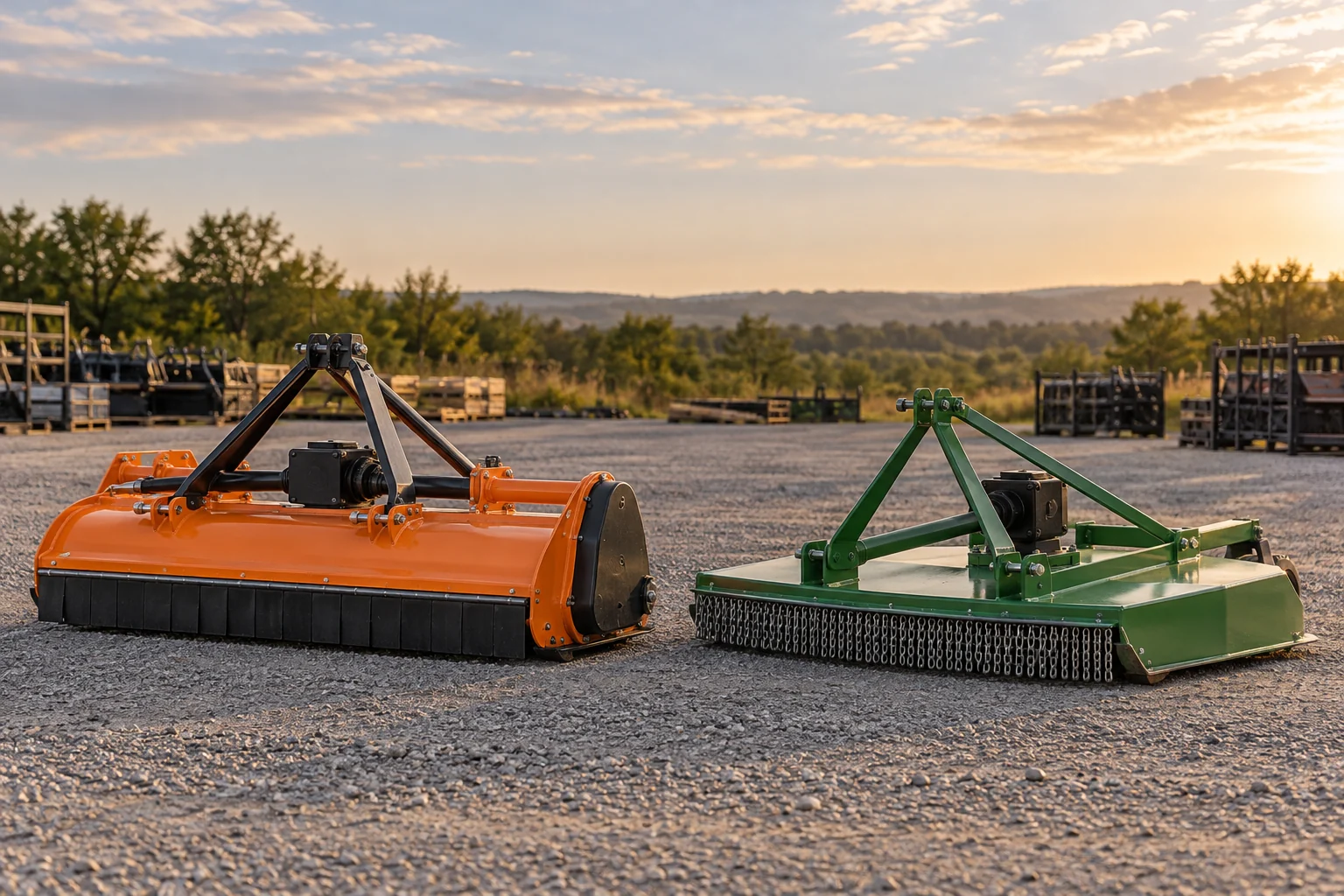
Choose a flail mower or rotary cutter by the vegetation, finish and tractor combination your business actually needs—not by which attachment looks tougher in a listing. A flail uses multiple cutters on a horizontal rotor; a rotary design uses blades turning around a vertical axis. Neither name alone tells you whether a specific machine fits your tractor, property or contract.
For a commercial buyer, the useful comparison is two complete, compatible equipment packages tested against the same work. Cutting width and purchase price matter, but so do the finished result, transport, wear parts and the number of paid jobs that will use the attachment.
Start with the job, not the category label
Write a short description of your recurring work before requesting prices. Include the type of vegetation, the expected appearance after mowing, access constraints and the approximate share of your season spent on that work. Ask the supplier to recommend a configuration against that description.
Trimax describes the different cutting geometries and the flail's repeated cutting and mulching action. Its comparison is useful for understanding the mechanisms, but it is not a specification for every agricultural cutter. In particular, do not confuse a rotary finish mower with a rotary brush cutter simply because both use a rotary design. Trimax manufacturer comparison.
That distinction prevents an expensive mismatch. A contractor maintaining a neat commercial property and one reclaiming an overgrown field may both say they need a mower. They have not necessarily described the same purchase.
| Buying question | What to ask for |
|---|---|
| What vegetation is in the contract? | Written confirmation that the proposed model fits the actual workload |
| What finish must the customer accept? | A demonstration or documented example relevant to that finish |
| What tractor will carry or power it? | Supplier confirmation using the exact tractor and attachment models |
| How does it travel between jobs? | Transport dimensions, weight and a separate delivery or hauling quote |
| Who supports it locally? | Parts availability, service contact and warranty responsibility |
This table is a purchasing checklist, not an operating or safety guide. Have the supplier and qualified personnel assess the site and equipment combination. Neither design makes unsafe sites or untrained operation acceptable.
Compare compatible packages before comparing prices
Two six-foot attachments are not automatically substitutes. Ask the dealer to identify the required tractor configuration, mounting arrangement, power requirements and any additional components. Get those details confirmed before paying a deposit.
Keep the compatibility review attached to the quote. A verbal “that should work” can disappear when another person handles delivery. The written record should identify the tractor, the attachment, the relevant options and who is responsible for checking the combination.
Then request a package price with these lines separated:
- Base attachment and exact model.
- Required mounting or connection components.
- Optional features that your job actually requires.
- Freight, delivery and supplier setup.
- Initial spare or wear parts that you choose to purchase.
- Taxes and any charges excluded from the advertised price.
Do not add a second implement merely to make a financing request larger. A package should represent a real business need, not an artificial purchase threshold.
A better cost comparison than dollars per cutting width
A lower sticker price can still be the right choice. The point is to test it against the work rather than assume that the more expensive machine pays for itself.
Consider this fictional example, not a market-price estimate or productivity claim:
| Budget item | Package A | Package B |
|---|---|---|
| Attachment | $12,000 | $16,000 |
| Required connection components | $1,000 | $500 |
| Delivery and setup | $1,000 | $1,000 |
| Initial wear-parts allowance | $500 | $500 |
| Initial package total | $14,500 | $18,000 |
Package B costs $3,500 more. Suppose a supplier demonstration and your own job records suggest it could reduce a separate cleanup task. Do not treat that as a saving until you estimate the actual paid work affected, the labor that would really be avoided and any extra upkeep.
If the verified annual net saving were $1,000, the simple recovery period for that $3,500 difference would be 3.5 years. That calculation excludes financing, taxes, resale value and changing workload. If the saving never materializes, the calculation has no value. Use conservative assumptions and keep the evidence beside each number.
Check the used machine beyond its paint
For used equipment, request the serial number, age, maintenance history and an independent condition assessment appropriate to the machine. Have a qualified inspector identify repairs and missing components; this article does not provide inspection or repair procedures.
Ask whether the seller's price includes a usable, complete attachment or a project that needs work before it enters service. Record who pays for transportation if you decline it after inspection. A bargain located far away can become less attractive once collection and return risk are visible.
Also ask for prices and lead times for the parts your service provider expects you to need. Do not assume that another machine of the same width uses the same components. The objective is to understand ownership costs before purchase, not to create an unsupported maintenance budget from a generic online average.
Match the purchase to seasonal utilization
Estimate use from actual contracts or a cautious forecast. Separate confirmed work from hoped-for work. An attachment that earns revenue for a short season still creates costs outside that season.
A simple decision sheet can show:
- Confirmed jobs requiring this attachment.
- Work that an existing machine or outside contractor can handle.
- Additional jobs that are plausible but not committed.
- Storage, transport and service costs for ownership.
- The cost of renting or subcontracting the same defined workload.
Keep customer pricing and machine productivity assumptions separate. Buying equipment does not guarantee that customers will accept a higher price or that your crew will finish a job faster.
Questions buyers often ask
Is a flail mower always better than a rotary cutter?
No. Compare the exact models against vegetation, finish, tractor compatibility and commercial workload. A category-level preference does not replace a supplier-supported specification.
Is the wider attachment always more economical?
Not necessarily. Width alone leaves out access, transport, the compatible tractor and the quality of work required. Compare the complete package and a realistic season of use.
Can I finance an attachment by itself?
That depends on the provider, purchase amount, equipment and borrower. Ask about the specific attachment and transaction. Do not assume a lender treats every implement or used private-party sale the same way.
Turn the selected configuration into a clear request
Once you have a compatible, itemized quote, review Dengaro's equipment financing requirements. Confirm the asset and seller are supported before proceeding. Financing terms and approval remain subject to provider review; the mower comparison does not establish eligibility.