
Gooseneck vs bumper pull: choosing a business equipment trailer
Compare business gooseneck and bumper-pull trailer packages by vehicle compatibility, actual loads and complete acquisition costs.
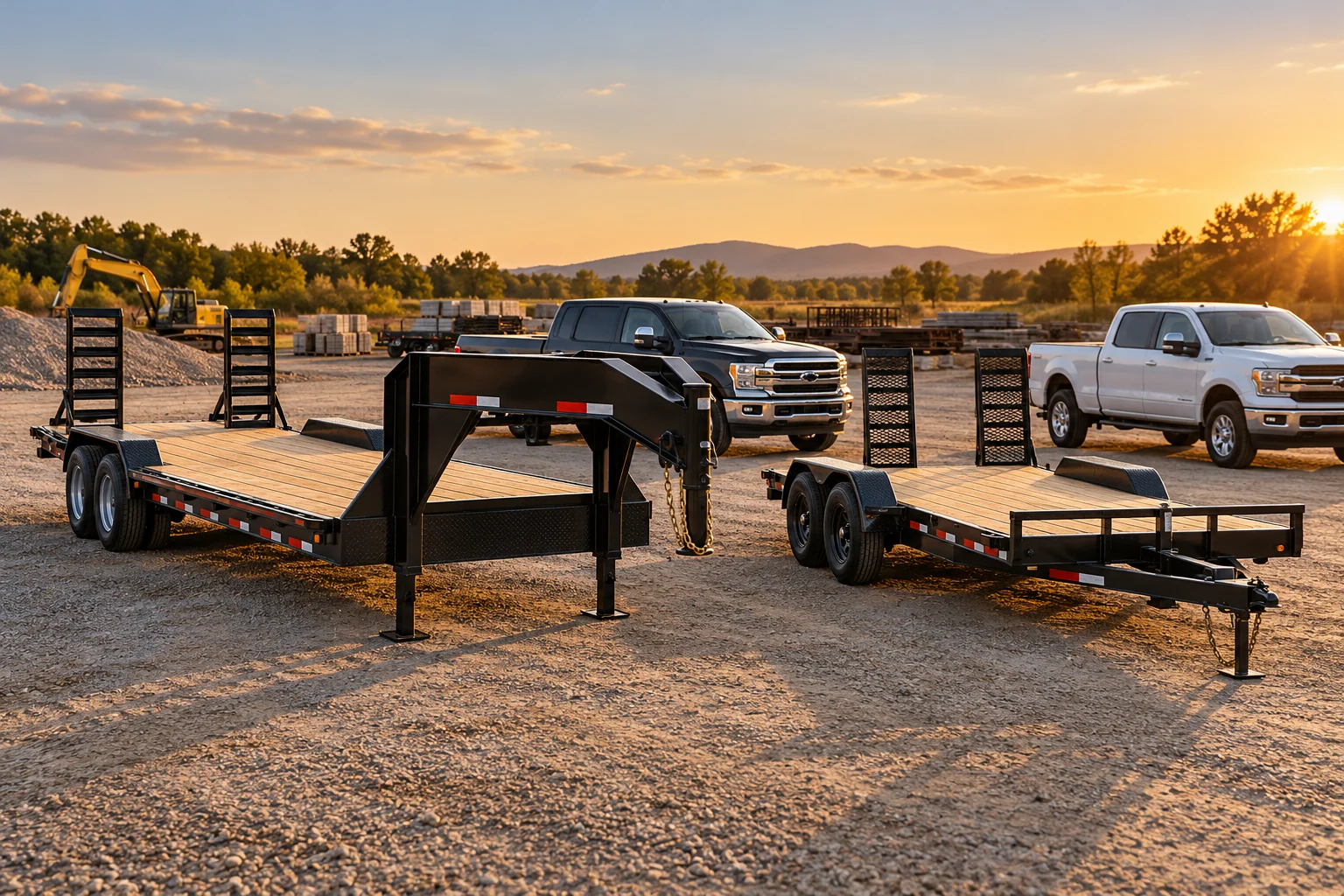
Choose between a gooseneck and a bumper-pull trailer by reviewing the complete truck-and-trailer combination for the loads your business actually moves. The connection type alone does not establish usable payload, legal suitability, safe towing or the lowest total purchase cost.
ARC's manufacturer guide describes a bumper-pull connection behind the tow vehicle at a frame-mounted receiver and a gooseneck connection inside the pickup bed. It also highlights differences in truck setup and bed use. Those are relevant buying considerations, not permission to tow a particular load. ARC hitch and chassis comparison
This guide is for commercial equipment-trailer procurement. Qualified dealers and appropriate transport specialists must verify vehicle compatibility, ratings, installation, load securement and applicable rules. It is not a towing or hitch-installation manual.
Start with the actual equipment list
Write down the equipment, attachments and supplies that must travel together. Use documented weights and dimensions from appropriate sources rather than guessing from photographs or the main machine's model name.
Separate a normal trip from an occasional maximum-load trip. If the rare load needs a different transport arrangement, compare that alternative instead of making every daily trip carry the cost of a larger combination.
Also record how the truck bed is currently used. A setup that interferes with an essential toolbox, service body or other business equipment may require additional changes. Ask the dealer to identify those conflicts before treating either trailer as a simple standalone purchase.
Compare equivalent trailer configurations
A gooseneck and bumper-pull quote may differ in much more than the coupler. Deck length, width, ramps, axles, brakes and optional equipment can make the prices describe different jobs.
| Purchase question | Evidence to request |
|---|---|
| Load fit | Qualified confirmation using the actual proposed loads |
| Trailer configuration | Exact model, dimensions and installed options |
| Tow vehicle | Confirmation for the particular vehicle and hitch setup |
| Loading arrangement | Suitability reviewed by qualified personnel |
| Bed and body compatibility | Written identification of required changes |
| Transport rules | Appropriate review for the planned business use |
| Delivery and preparation | Included work versus additional charges |
| Service | Warranty, parts and local support arrangements |
Do not assume the largest advertised rating is the available capacity of your whole combination. Have qualified specialists review every relevant limit and the effect of the installed configuration. This article does not calculate allowable towing capacity.
The existing truck is part of the business case
A trailer can be affordable on its own while requiring a costly change elsewhere. Ask whether the business can use its current vehicle as configured, needs professionally installed equipment or would need a different vehicle altogether.
Get those costs in writing. Avoid comparing a bumper-pull trailer attached to an already suitable vehicle with a gooseneck trailer that assumes an unpriced truck change. The reverse can happen too: a business may already own a suitable gooseneck setup but need modifications for a different combination.
The decision should include what the truck must do when the trailer is not attached. A purchase that complicates another daily task has an operating consequence even if it does not appear on the trailer invoice.
Use a complete-package comparison
Here is a fictional purchasing example, not a price estimate or a recommendation that these combinations are suitable.
| Assumed cost | Proposal A | Proposal B |
|---|---|---|
| Trailer as specified | $18,000 | $22,000 |
| Required vehicle setup | $4,000 | $1,000 |
| Delivery and preparation | $1,000 | $1,000 |
| Total | $23,000 | $24,000 |
The trailer prices differ by $4,000, but the complete assumed packages differ by $1,000. The example deliberately does not assign a hitch type to either proposal: your existing vehicle and required configuration determine the real costs.
If a provider considers only the trailer and excludes vehicle modifications and delivery, the unfunded amounts would be $5,000 for A and $2,000 for B. Actual cost eligibility must be confirmed; do not assume that an entire transport project qualifies as one equipment purchase.
Test the purchase against the work calendar
List the jobs that require the trailer, how often they occur and whether the business has another transport option. Keep confirmed contracts separate from potential work.
For example, a fictional $6,000 annual fixed-cost allocation equals $100 per use at 60 uses or $50 at 120 uses, before fuel, labor, maintenance and other variable expenses. This is not a towing cost estimate. It shows how utilization affects the ownership case.
Compare actual outside-hauling or rental quotes for the same tasks. Include the coordination and availability requirements of those options. A trailer that is inexpensive per use only under an optimistic workload forecast may not be the strongest purchase today.
Inspect used trailers as specific assets
Request the VIN or serial number, title or ownership documents, configuration, maintenance history and a qualified inspection. Clarify whether ramps, jacks and other advertised accessories are included in the sale.
Have qualified personnel assess condition and suitability rather than relying on a freshly painted appearance or a seller's description. Ask the seller to document known damage and repairs. The finance provider may also have requirements for age, seller and ownership evidence.
Price any required repairs or configuration changes separately. A lower asking price does not establish a lower ready-for-business cost, and an online listing does not confirm current availability.
Common buying questions
Is a gooseneck always the better commercial choice?
No. Compare the actual load, vehicle, configuration, work pattern and total cost. Neither connection type replaces a qualified review of the complete combination.
Does bumper pull mean attaching directly to a bumper?
The cited manufacturer describes a frame-mounted receiver arrangement. Have a qualified professional identify the proper, rated equipment for the specific vehicle and trailer; do not infer compatibility from the nickname.
Can I increase the purchase size to meet a financing minimum?
Only include equipment the business genuinely needs and is actually buying. Do not inflate an invoice or add unrelated assets solely to fit a provider's threshold.
Finance the approved configuration
Once compatibility and purchase scope are settled, review Dengaro's equipment-financing requirements. If you start an enquiry, provide the exact trailer, seller, condition and itemized costs. Eligibility, approval and terms require provider review.