
LiDAR scanner price: a commercial buyer’s budget guide
Compare a dated LiDAR package price with software, accessories and delivery costs to build a practical commercial scanning budget.
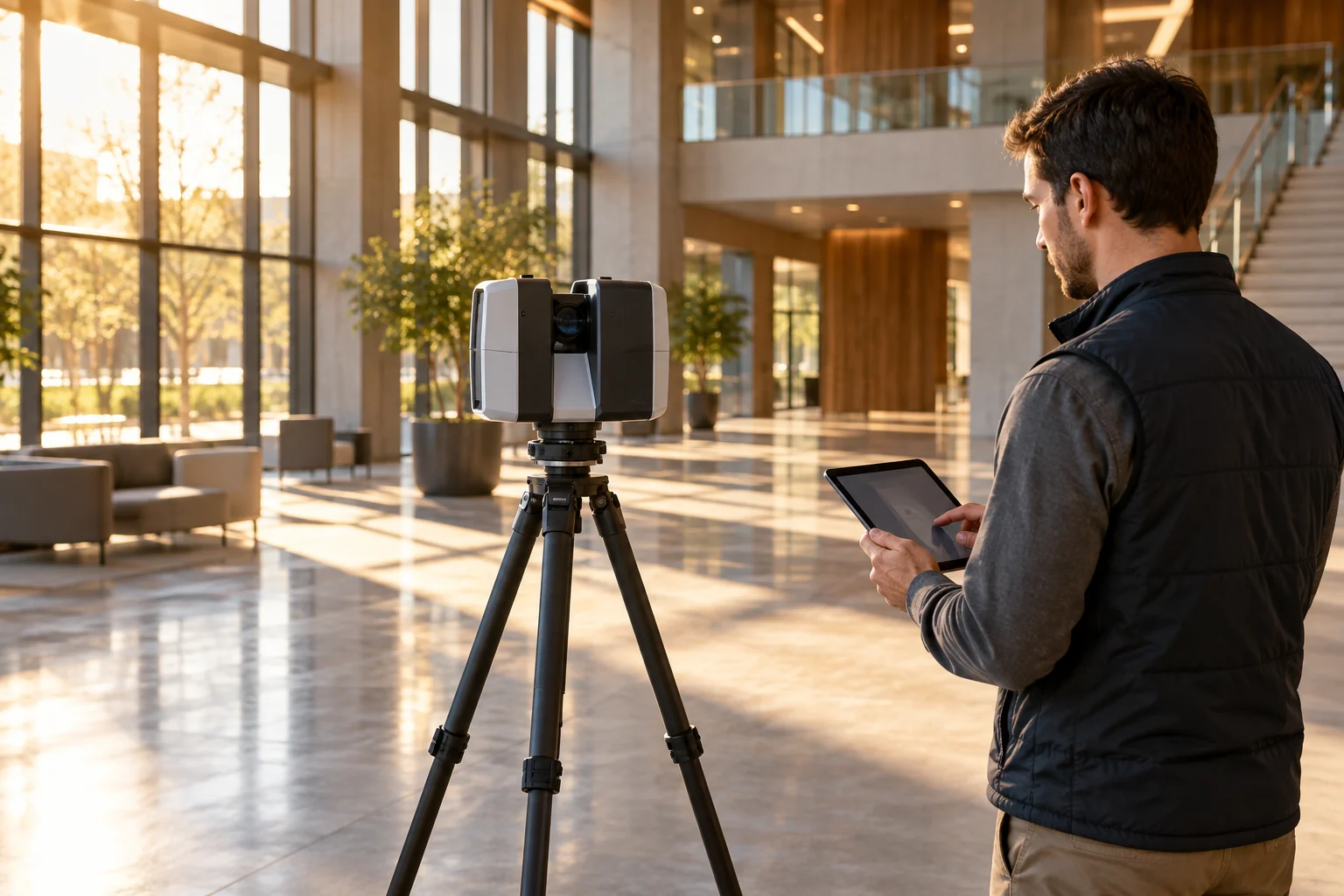
A LiDAR scanner price should identify the complete capture-and-delivery system your business needs. A sensor, a tripod-mounted scanner and an aerial mapping package are not interchangeable purchases. Comparing their headline prices without software, accessories and the intended deliverable can produce a misleading budget.
For one concrete reference, Leica’s purchasing page displayed $26,500 for its BLK360 hardware package when reviewed on October 30, 2026. That is a specific manufacturer package, not a market-wide LiDAR price or the cost of every complete scanning workflow. Request a current, location-specific quote for your exact configuration. Leica BLK360 purchasing page
This guide shows how to make the quotation specific enough to compare. It concerns professional equipment acquisition, not a phone's built-in sensor, a consumer app or the price of hiring a scanning service.
What the advertised package includes
The same Leica page lists a BLK360 scanner, a six-month Hexagon GeoCloud license with 500GB data usage, three batteries, a multicharger, a transport case, a USB-C cable and a cleaning cloth. Confirm the final invoice, regional terms, tax and delivery before treating the displayed price as your purchase total.
Ask which software functions you need beyond that package, what renewals will cost and which accessories your work requires. A limited-duration cloud license should not be budgeted as permanent access. This example also cannot stand in for an aerial payload, aircraft package or mobile system: compare like-for-like scopes.
Name the deliverable before choosing the scanner
Ask the people responsible for the work to define what must be delivered to the customer. That may include a required file format, documented quality criteria, compatible software and a review process. Do not choose a scanner solely from a resolution or accuracy headline.
For example, Leica describes the BLK360 as an imaging laser scanner with a workflow connected to its reality-capture software. DJI describes the Zenmuse L2 as an aerial LiDAR system used with flight platforms and DJI Terra. These illustrate different system scopes; their product names alone do not prove equivalent output or a complete purchase package. Leica BLK360, DJI Zenmuse L2
Keep these questions separate:
- Can the proposed system capture what the job requires?
- Can your team process and check the data?
- Can it deliver files the customer can actually use?
- Is the intended work within the business's professional qualifications and permissions?
Qualified specialists must determine measurement suitability and any surveying, engineering or aviation requirements. Purchasing equipment does not confer a professional credential or permission to operate it.
Compare packages within the same class
A useful quotation request identifies whether you need a terrestrial scanner, a mobile capture system or an aerial payload and platform. Ask the supplier to explain what is included in the quoted configuration and what must be supplied separately.
For an aerial proposal, do not assume a payload price includes the aircraft, batteries, processing software or other equipment. For a terrestrial proposal, do not assume a scanner-only price includes every accessory and software license used in the demonstration.
Use a scope table:
| Budget item | Written confirmation to obtain |
|---|---|
| Capture equipment | Exact model, configuration and condition |
| Platform and accessories | What is included versus separately required |
| Field software | License type, device compatibility and renewal terms |
| Processing software | Included functions, export options and ongoing fees |
| Computing and storage | Requirements for the intended workload |
| Training | Scope, attendees and follow-up support |
| Service and calibration | Applicable requirements, provider and cost |
| Delivery | Shipping, taxes and any handover charges |
Do not treat optional and required items alike. Ask which components are essential for your agreed deliverable and which merely expand future capabilities.
Test the workflow from capture to accepted files
Ask suppliers to demonstrate a representative project, then have your qualified team evaluate the result against the written requirements. A visually impressive point cloud is not by itself proof that the final deliverable meets the customer's needs.
Record the time for capture, transfer, processing, review and export. Identify any outside labor or additional software used. If a supplier completes the demonstration with a higher-tier license or a different computer, make that difference visible in the quote.
This is an acceptance-planning exercise, not guidance on flight routes, survey controls or technical measurement procedures. Those belong with qualified professionals and the relevant manufacturer instructions.
Also ask how your files remain accessible if a subscription expires. Confirm export rights, storage arrangements and handover responsibilities before building a business workflow around an assumed feature.
Build a first-year budget, not just a hardware total
Consider this fictional purchasing example. The figures explain the worksheet; they are not LiDAR market prices or supplier quotes.
| Assumed item | Amount |
|---|---|
| Defined capture hardware package | $24,000 |
| Required accessories | $3,000 |
| Initial software licenses | $4,000 |
| Computing and storage | $3,000 |
| Training and handover | $2,000 |
| Initial acquisition total | $36,000 |
If the provider's proposed financing covers only $27,000 of hardware and accessories, $9,000 remains outside that scope. Confirm the actual treatment of licenses, computers and training; providers may differ.
Keep future renewals, staff time, service and operating expenses in a separate budget. Do not count the same license both in a bundle and as an extra. Equally, do not omit a renewal because the first year is included.
Compare owning with project-based alternatives
If demand is uncertain, compare a purchase with actual rental or subcontracting quotes for your expected jobs. Include the time and expertise your team must contribute in either case.
For example, if an invented ownership plan has $12,000 in annual fixed costs allocated to this service, that is $600 per project at 20 projects, or $300 at 40 projects, before project-specific costs. These are arithmetic examples, not expected utilization or earnings.
Do not double the projected job count simply to make ownership appear cheaper. Separate committed work from a growth case and ask what happens if demand arrives later than planned.
For used equipment, confirm the unit's condition, service history, software-transfer arrangements and continuing support. The ability to buy a scanner does not establish that its complete workflow remains supported.
Common price questions
Why are two LiDAR quotes so far apart?
First check whether they cover the same equipment class, software, accessories, support and deliverable. A payload-only price and a complete aerial system price answer different questions.
Should I buy based on advertised accuracy?
Have qualified specialists assess suitability for the actual work and acceptance requirements. A single specification does not establish professional compliance or an equivalent end-to-end result.
Can specialty scanning equipment be financed?
The provider must confirm the exact equipment, seller, condition, business and transaction. General equipment-financing information does not establish specialty eligibility.
Request the system you intend to use
With a defined deliverable and itemized package, review Dengaro's equipment-financing requirements. If you start an enquiry, ask first whether the specific specialty purchase fits available options. Approval, eligible costs and terms remain subject to provider review.