
Mass spectrometer price: a commercial buyer’s budget guide
Build a mass spectrometer purchase budget around the exact system, software, site readiness, installation and documented support—not a generic price range.
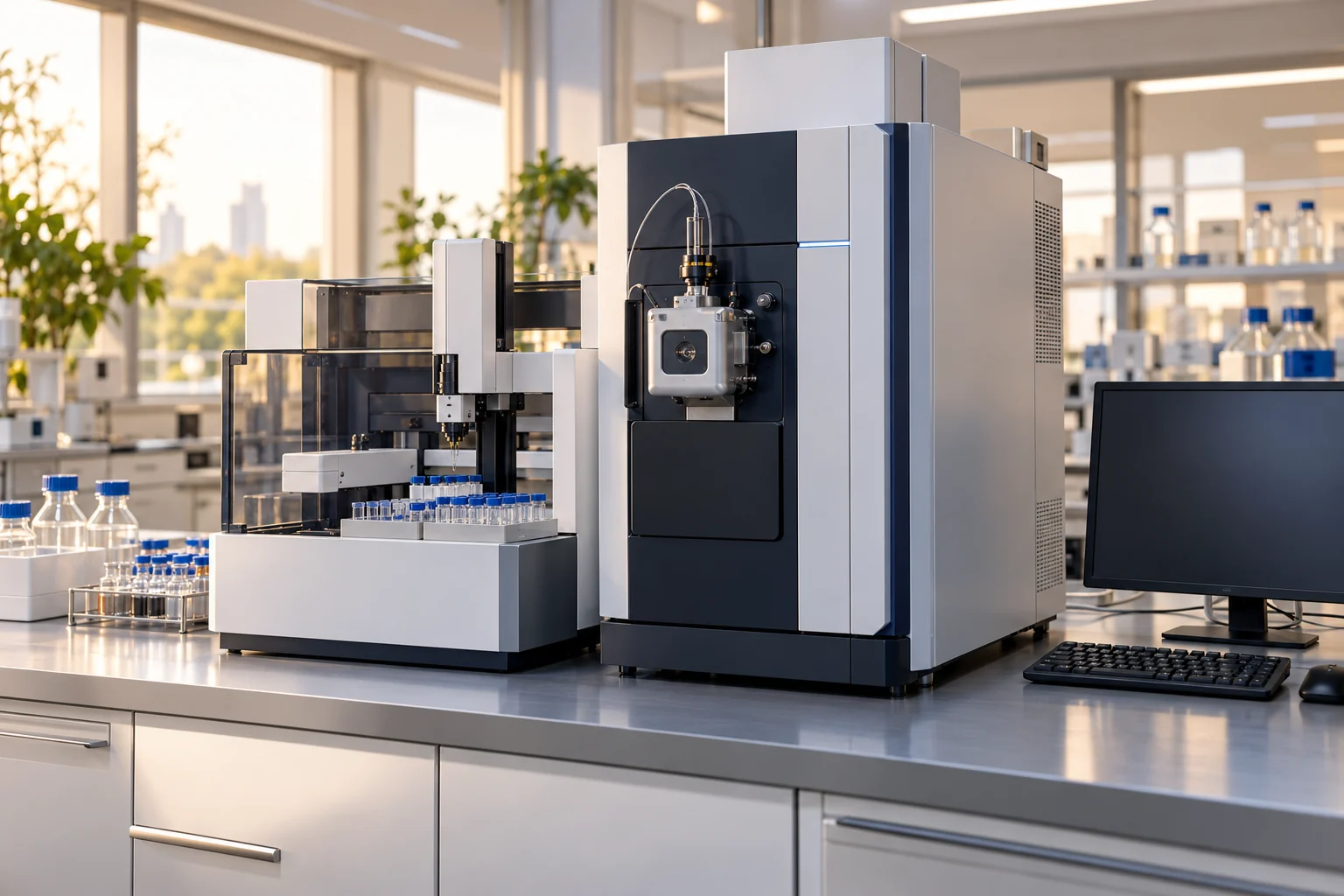
A useful mass spectrometer price is the price of a defined, supported system—not just an instrument name. For a commercial laboratory, the budget should identify the analytical configuration, sample-handling equipment, software, installation and site work required. A used instrument listing can be a reference point, but it is not a reliable price range for every mass spectrometry workflow.
For one specific example, a Marshall Scientific page reviewed on October 30, 2026 displayed $124,345 for a recertified Agilent 6545A Q-TOF package with selected options. It also displayed out of stock—call for availability. That is a dated advertised reference, not an available offer, a transaction price or a market average. Source: Marshall Scientific's 6545A listing.
This guide is a procurement worksheet. It does not select an analytical method, establish clinical suitability or tell a laboratory how to install or operate an instrument.
Begin with the laboratory's requirement, not a broad price range
Have the qualified laboratory team describe what the system must accomplish before requesting competing quotes. Otherwise, two sellers may price different configurations under the same broad equipment category.
The request should state the intended work, sample types, expected workload and the team's required performance criteria. Ask the supplier to identify which configuration meets those requirements and how it proposes to demonstrate that fit. Do not choose a detector or analytical platform solely because a cheaper listing is available.
Throughput needs deserve particular care. Record the workload the business actually expects, not just a desirable maximum. Ask what the quoted configuration includes to support that workflow and which assumptions depend on the laboratory's methods, staff or sample preparation. A product's headline speed is not a guarantee of billable output.
Keep commercial questions separate from scientific ones. Purchasing can compare included modules and payment milestones; qualified specialists must assess whether the system is suitable for the work.
Compare complete packages on one sheet
Use an inclusion matrix before comparing the headline prices:
| Budget line | What to establish in each quote |
|---|---|
| Mass spectrometer | Exact model, configuration, condition and unit identity when available |
| Front-end equipment | Whether required chromatography, autosampling or other sample-handling equipment is included |
| Supporting hardware | Which pumps, gas equipment, accessories and connections are supplied |
| Software and data station | Named software, licenses, computer configuration and support responsibilities |
| Delivery and installation | Scope, travel, placement and acceptance activities included |
| Site preparation | Work the facility must complete separately before installation |
| Training and support | What is provided, to whom, for how long and under what written scope |
| Initial operating supplies | What is included at handover and what must be purchased separately |
A blank line means “not confirmed,” not “included.” Ask the supplier to return a completed version with the quote.
The Marshall listing, for example, identifies a vacuum pump, ion source, data station, installed software and test reports among its package contents. Those details matter more than treating its advertised number as the price of a generic mass spectrometer. Confirm the complete current package and licensing in a written quote rather than assuming every component needed for your workflow is supplied.
Keep the site budget separate from the instrument budget
Buying the instrument does not mean the laboratory is ready for it. Ask for the current site-preparation requirements for the exact configuration and have the appropriate facility specialists review them.
Agilent's site-preparation service describes checks covering gas and electrical connections, space, plumbing, HVAC and computer/network compatibility. That supports treating site readiness as a separate purchasing workstream; it is not a universal specification for every instrument. Source: Agilent site preparation.
Record who owns each outstanding site item, the quoted cost and when it must be completed. If the instrument cannot be installed until a facility change is finished, show that dependency in the purchase plan. Do not assume delivery and productive use occur on the same day.
This is not a guide to utility installation or gas handling. Use the manufacturer's requirements and qualified professionals. Nor should a buyer substitute a general article for the laboratory's own safety and compliance review.
Evaluate used and refurbished offers by their actual support
“Used,” “refurbished” and “certified pre-owned” are not enough to compare two offers. Ask who performed the work, what testing was completed, what records accompany the system and who will provide service after delivery.
Agilent's own certified pre-owned program describes refurbishment to specified performance standards, installation support and a 12-month warranty. Those are statements about that manufacturer's program—not promises attached to every used Agilent instrument sold by someone else. Source: Agilent certified pre-owned instruments.
For each candidate, have the supplier confirm:
- The exact unit and included accessories.
- The available service and refurbishment records.
- The software licensing and support arrangement for the buyer.
- Who will install it and what acceptance documentation is provided.
- The written coverage and exclusions for this purchase.
- Whether parts and service are available for the intended operating period.
If an answer is unavailable, preserve that uncertainty in the comparison. A lower purchase price does not resolve missing support or an unsuitable configuration.
Build an acquisition budget without inventing a market average
The following figures are entirely fictional. They illustrate how to structure a quote, not what a mass spectrometer or installation should cost.
| Item | Illustrative amount |
|---|---|
| Defined instrument package | $120,000 |
| Additional required sample-handling equipment | $25,000 |
| Quoted site work | $12,000 |
| Delivery and installation not included above | $8,000 |
| Separately quoted software and training | $5,000 |
| Acquisition subtotal | $170,000 |
If a financing proposal covered only the $120,000 instrument package, $50,000 of this illustrative subtotal would remain outside it. That does not establish how a real provider treats any line item. Ask for the actual financed scope, required cash and conditions.
Keep ongoing supplies, service renewals, staffing and other operating expenses in a separate operating budget. Do not bury recurring costs in the acquisition subtotal or count them twice. Have the lab team replace estimates with actual workflow requirements and supplier quotes.
Also separate technical acceptance from business payback. Even a properly specified system does not guarantee sample demand, revenue or a particular return on investment.
Turn the budget into a clear purchase request
The final package should contain the laboratory's approved requirement, the itemized supplier quote, site-readiness responsibilities and the proposed acceptance process. Identify unresolved costs before requesting financing rather than filling gaps with a convenient rounded number.
For a business purchase, Dengaro's equipment financing requirements offer a starting point for organizing the request. Confirm whether the specific laboratory equipment, seller, condition and transaction are supported. Neither a supplier price nor a purchase total establishes eligibility or approval.
The key question is not simply “How much is a mass spectrometer?” It is: What will this defined system cost to acquire and put into the laboratory's intended workflow, and which costs remain outside the proposed financing?