
Pallet jack vs forklift: choosing equipment for your business
Choose pallet jacks or forklifts by the work required: floor-level movement, elevated placement and support for an existing handling plan.
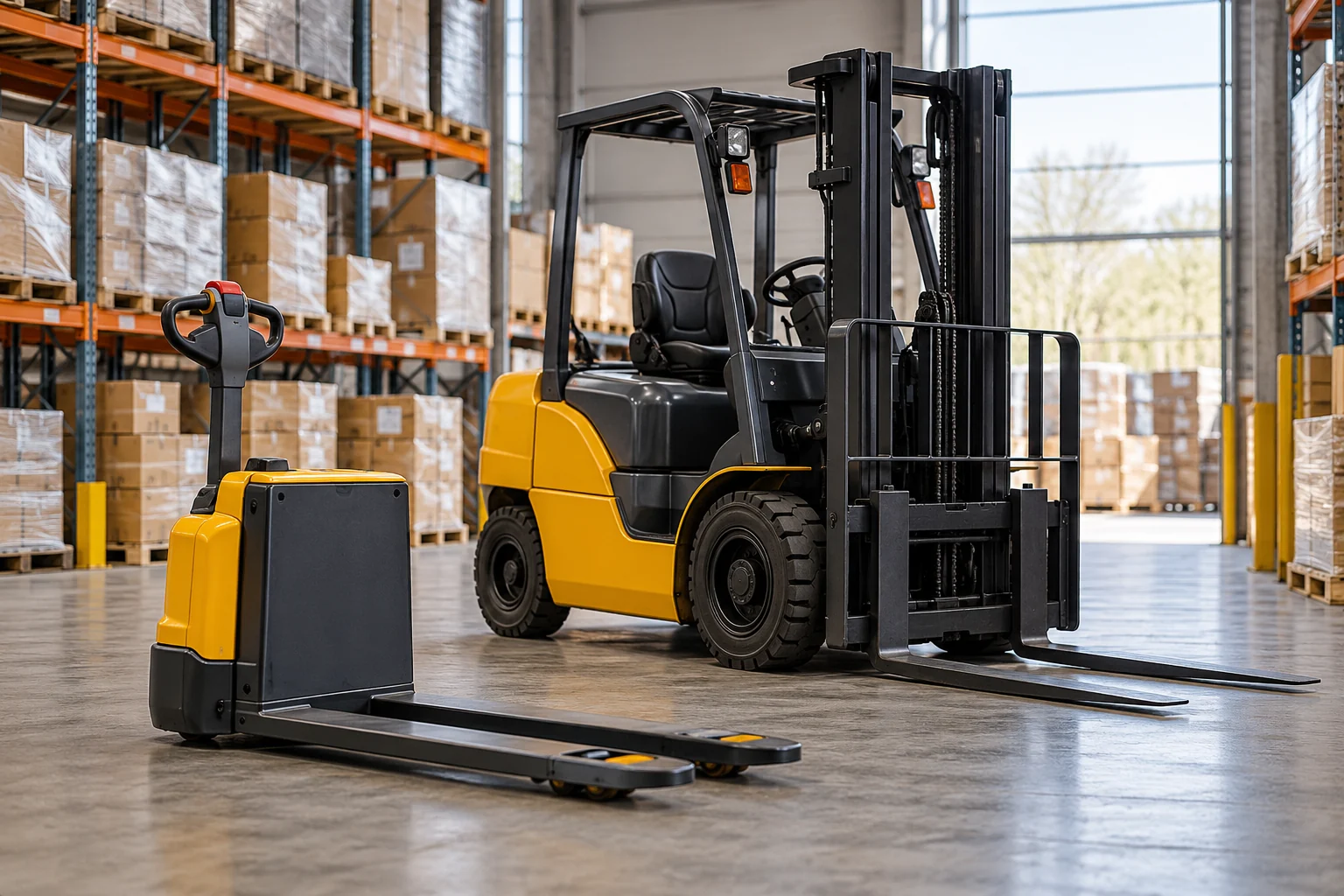
A pallet jack is usually considered for moving palletized loads over short vertical distances, while a suitable forklift can also place loads at storage or loading heights. The buying question is not simply which costs less. It is whether the business needs horizontal movement, elevated placement, or both—and which exact equipment is approved for that work.
Toyota describes its electric walkie pallet jack as equipment controlled by an operator walking alongside it. Its separate product range includes hand pallet jacks and other material-handling equipment. Do not confuse a low-lift pallet jack with a walkie stacker or assume that all machines operated on foot do the same job. Toyota electric pallet-jack FAQ, Toyota hand pallet jacks
This is a purchasing guide for a commercial workflow. Equipment selection, safe use and training need qualified assessment; the article is not a load-handling procedure.
Separate movement from placement
List the steps that happen after a pallet arrives. Does it travel from a receiving point to a floor-level staging area? Does it then need to enter racking? Does another machine already perform that second step?
Those details can reveal a better question than “pallet jack or forklift.” You may be deciding whether a pallet jack can support an existing forklift by handling appropriate floor-level movement. Or you may be trying to replace a forklift that still performs essential elevated placement.
Do not count a task as covered merely because the pallet can be lifted off the floor. Ask the dealer to confirm every required movement and destination for the actual load and environment.
Compare the three proposals you might receive
| Proposal | Main purchasing issue to resolve |
|---|---|
| Hand pallet jack | Whether its approved use fits the work and the team's assessed handling requirements |
| Powered pallet jack | Whether powered travel and the exact configuration fit routes, workload and support arrangements |
| Forklift | Whether its lifting and handling capabilities are needed for the assigned tasks |
This table is not a recommendation to use one category on a particular surface, slope or vehicle. Have qualified staff and the supplier evaluate those conditions. Similar-looking forks do not establish equivalent capability.
If a dealer proposes a stacker, assess it as its own configuration rather than quietly treating it as a pallet jack. Ask why that equipment fits the task and what limitations apply.
Find the expensive waiting time
A business may own a forklift but still lose time because the truck is occupied with work that could be assigned elsewhere. Record when workers wait, what they wait for and what task the forklift is completing.
For a hypothetical example, suppose a warehouse records 45 minutes of forklift waiting time across a shift. That is not automatically 45 minutes of recoverable paid labor or additional production. Some waits overlap; some work cannot move until another process finishes.
Use the log to design a realistic trial with qualified supervision. Measure whether the proposed equipment changes the bottleneck. Do not convert every observed minute into a guaranteed saving or use a supplier's best-case cycle time as a business forecast.
A modest supporting machine can be useful without replacing a larger one. Equally, another machine may add storage, charging and service demands without solving the actual delay.
Budget for the whole handling plan
Compare complete plans, not a low pallet-jack price against a fully equipped forklift quote.
Consider this invented example, not a market-price guide:
| Equipment plan | Hypothetical acquisition cost |
|---|---|
| Replacement forklift package | $36,000 |
| Two supporting powered pallet jacks | $12,000 |
| Delivery and agreed setup | $2,000 |
| Combined equipment plan | $50,000 |
If the business only needs the two pallet jacks, its actual request is $12,000 before other verified costs—not $50,000. Do not add an unnecessary forklift or inflate a package to meet a provider's minimum transaction size.
If all three machines are genuinely required, document the job assigned to each and request a quote with separate line items. Ask which items the proposed provider can consider. Eligibility for one asset does not establish eligibility for all related costs.
Look beyond the delivery date
Identify where equipment will be stored, how it will be supported and which team owns its upkeep. For powered equipment, have qualified specialists confirm the appropriate charging arrangements for the exact configuration.
Request written details of the battery, charger, warranty, service provider and included training where applicable. Do not assume a battery shown in a photograph or a charger used in a demonstration is included in the sale.
For used equipment, obtain exact model and unit identification, condition information and an assessment by qualified personnel. A low purchase price can be difficult to compare if support, parts or required work remain unresolved.
This is particularly important when several small machines are bought from different sellers. A combined budget is not the same as a consistent service plan.
Keep the business case honest
Before deciding, answer four questions in plain language:
- Which current task will this machine own?
- Which required tasks will it not perform?
- What other equipment or support must remain available?
- What result will tell us the purchase addressed the original problem?
If the answer to the first question is vague, pause the purchase comparison. More equipment is not necessarily more useful capacity.
Set a review date after implementation to compare the actual result with the original assumptions. Measure the process you intended to improve, rather than looking only at how often the new machine is used.
Common buying questions
Is a pallet jack a substitute for a forklift?
Only for tasks that fit the specific equipment's approved use. A low-lift pallet jack should not be treated as a replacement for required elevated placement.
Does powered always mean better?
No. Match the exact equipment to the workload and have handling, site and training requirements assessed. Purchase price and powered travel alone do not establish suitability.
Can a business finance a small pallet-jack purchase through Dengaro?
Review the current requirements and ask about the actual transaction. A small standalone purchase may fall outside the available scope. Do not create an artificial bundle simply to increase the request.
Choose the role before the equipment
Once your team has a defined handling plan, review Dengaro's equipment-financing requirements. You can start an enquiry for a genuine itemized business purchase, subject to provider confirmation of equipment eligibility, approval and terms.