
Pipe bursting equipment cost: a commercial buyer’s budget guide
Build a pipe bursting equipment budget around the complete system, tooling, supporting assets and documented purchase scope.
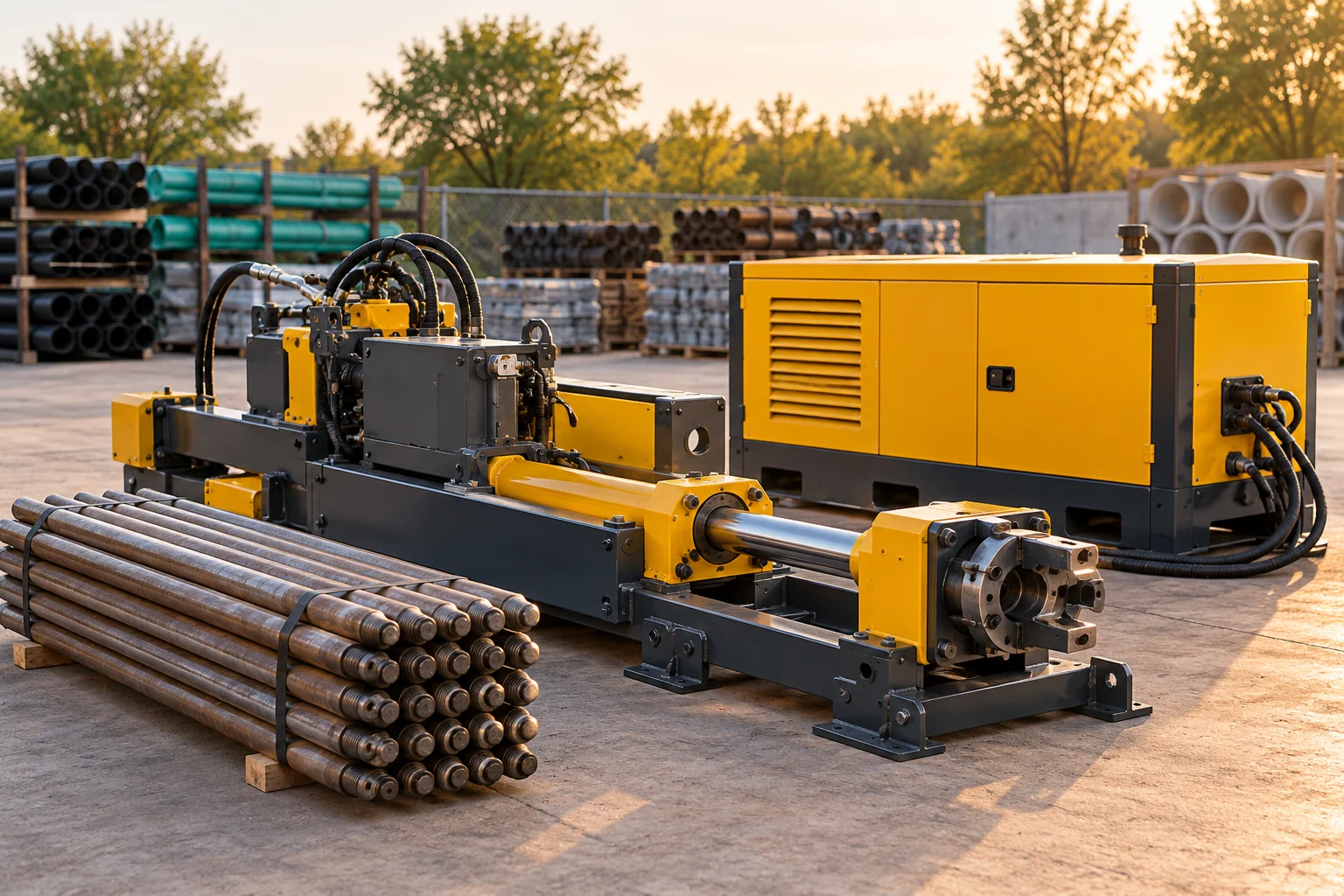
Pipe bursting equipment cost depends on the exact system, tooling and support equipment required for the work your qualified team has approved. A pulling unit alone is not necessarily a complete purchase package, and a contractor's price per foot is not an equipment purchase price.
TT Technologies' GRUNDOBURST manufacturer page describes a family of static pipe-bursting systems and associated components. The page reviewed on October 30, 2026 did not provide a public purchase price. Request a configuration-specific quote rather than using an invented market range. TT Technologies GRUNDOBURST
This article is for commercial procurement, not underground-work design or operating instructions. Qualified engineers, utility owners and appropriate safety specialists must establish project suitability and requirements. Purchasing equipment does not authorize work on a pipe or utility system.
Separate the equipment decision from the project method
Before seeking prices, have qualified personnel determine which equipment approach is appropriate for the intended work. Do not assume that every pipe, location or replacement project is suitable for the same system.
The purchasing brief should identify the approved application scope without asking a finance provider to make engineering decisions. A supplier can then quote the equipment configuration and clearly state the boundaries of its proposal.
TT Technologies' page distinguishes the hydraulic system and associated rods and tooling. That supports treating the package as more than one headline machine price. It does not establish suitability for a specific underground project or eliminate excavation and other supporting work. Manufacturer system overview
Ask what the quotation actually includes
Request an itemized equipment list with model numbers, quantities and condition. Have the vendor distinguish required components from optional items and from equipment your business already owns.
| Purchase component | Written confirmation to obtain |
|---|---|
| Main unit | Exact model, configuration and intended application scope |
| Power equipment | Included unit or approved separately supplied equipment |
| Rods and tooling | Quantities, compatibility and required accessories |
| Transport and storage | Included carriers, handling arrangements and delivery |
| Supporting assets | Existing equipment the supplier assumes is available |
| Training and handover | Scope, qualified participants and documentation |
| Service | Support coverage, parts availability and exclusions |
| Acceptance | Agreed evidence that the supplied package meets the purchase brief |
This table is not a jobsite checklist. It is a way to make the commercial proposal complete before your qualified team decides whether to accept it.
Do not confuse equipment cost with installed pipe cost
A project estimate can include engineering, permits, access work, crews, replacement materials, restoration and other obligations that are not the equipment purchase itself. Conversely, an equipment listing may exclude almost all those costs.
Keep a capital-purchase table separate from project operating budgets. If you mix them together, a machine supplier's quote and a contractor's project price can appear comparable when they answer different questions.
The business should also identify what work remains outsourced after it buys the system. Owning a specialized machine does not mean the company has every skill, approval or supporting asset needed to perform a project.
A fictional package makes the exclusions visible
The following numbers are invented solely for budget planning. They are not prices for a GRUNDOBURST system or any other named product.
| Assumed item | Amount |
|---|---|
| Main equipment unit | $75,000 |
| Specified rods and tooling | $18,000 |
| Supporting power equipment | $12,000 |
| Freight and training | $5,000 |
| Acquisition total | $110,000 |
If the finance proposal considers $105,000 of equipment but excludes freight and training, the business has a $5,000 gap. Actual eligible costs must be confirmed by the provider.
Now suppose another quote lists a $68,000 main unit but excludes $29,000 of required components and $6,000 of delivery and handover. Its complete assumed total is $103,000, not $68,000. That may still be less expensive, but only after qualified personnel establish that both packages meet the same approved requirement.
Evaluate utilization by the appropriate work
Build the ownership case from projects that genuinely fit the approved equipment scope. Do not count every underground construction job as potential use for the machine.
For a fictional allocation, $30,000 of annual fixed ownership costs spread across 30 suitable projects equals $1,000 per project. At 15 projects, it becomes $2,000, before crews, materials, transport and other project-specific costs.
Those numbers are not project prices, profit estimates or expected production rates. They simply show the effect of utilization. Compare real rental, subcontracting or partnership proposals for the same work where those options are available.
Separate signed contracts from opportunities still being pursued. A larger purchase may depend on demand the business has not yet secured, and that uncertainty should be visible rather than hidden inside an optimistic cost-per-project figure.
Used systems require a component-by-component review
Collect the serial number, service history, configuration and a qualified condition assessment for the main unit. Then verify the included rods, tooling, power equipment and accessories individually.
Ask the manufacturer or qualified service provider about compatibility and remaining support. Missing or mismatched components can turn a low asking price into a much larger acquisition project. Do not infer that all items shown in a photograph are included.
Obtain a written acceptance plan and clarify who pays for repairs, transport and any required preparation. A listing's condition label is not a substitute for independent technical assessment.
Questions to resolve before purchase
Can I use a price-per-foot estimate to choose equipment?
Not by itself. A project estimate includes assumptions about work scope and operating costs. Obtain a separate equipment quote and qualified application review.
Is the most powerful system always the best purchase?
No. Qualified specialists should determine the appropriate configuration. Additional advertised capability may add cost without solving the work your business actually has.
Can specialized trenchless equipment be financed?
Ask the provider to review the exact equipment, seller, condition and transaction. General equipment-financing information does not establish approval for a particular specialty system.
Take an itemized equipment request forward
Review Dengaro's equipment-financing requirements after the technical scope is settled. If you start an enquiry, separate the equipment purchase from project operating expenses and confirm which costs can be considered. Approval and terms require provider review.