
Reach truck vs forklift: choosing equipment for your business
Compare reach trucks and counterbalance forklifts by warehouse roles, handoffs and the complete equipment plan—not headline lift figures.
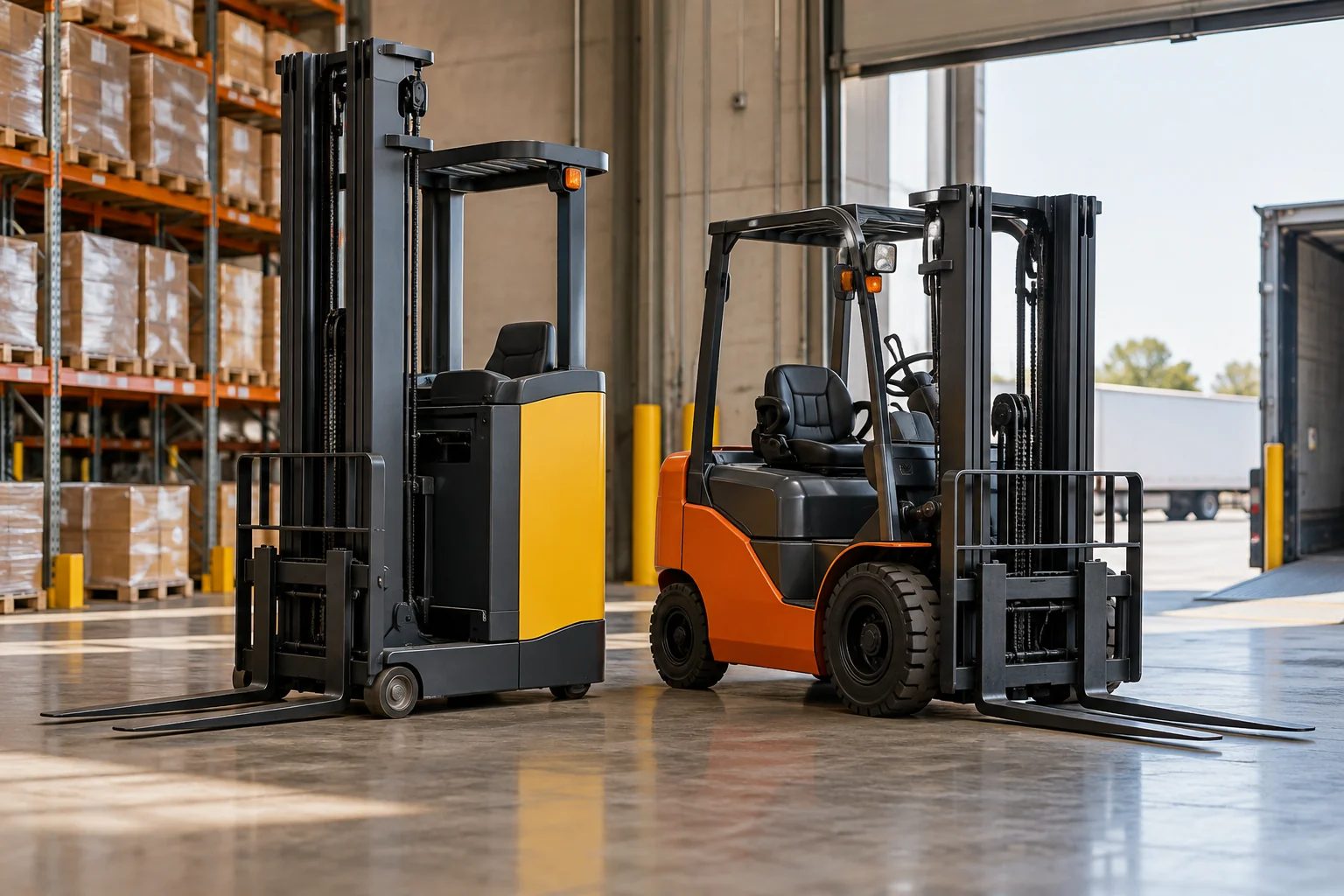
A reach truck is a type of forklift. The useful buying comparison is between a reach truck designed around pallet racking and a counterbalance forklift used for broader material-handling tasks. Start with the work that must happen between receiving, storage and dispatch—not which machine looks smaller or has the higher headline lift specification.
Toyota's manufacturer comparison distinguishes narrow-aisle, high-density storage from general handling and loading-dock work. It also lists different reach-truck configurations, including a model intended for limited indoor/outdoor use under suitable conditions. Those distinctions are a starting point, not permission to use any truck in any environment. Toyota's reach-truck comparison
This guide helps a business choose an equipment role before requesting a quote. It does not provide operating instructions, certify a warehouse layout or replace a qualified site assessment.
Map the handoff, not just the rack aisle
Draw the path a typical pallet takes from delivery to its final storage position and back to dispatch. Mark each point where a different machine or person takes responsibility. Include the busiest period of the day, not only the average workload.
Ask your team where the delay actually occurs. Is the receiving area full because pallets cannot be put away? Is rack access constrained? Or is a capable storage truck waiting because nothing is being staged for it?
A dedicated reach truck may address a rack-storage constraint without resolving a receiving bottleneck. A counterbalance truck may cover several general tasks without being suitable for the proposed rack layout. Treat those as separate questions until your equipment specialist confirms the configuration.
Compare roles rather than generic maximums
| Purchase question | Reach-truck proposal | Counterbalance proposal |
|---|---|---|
| Main assigned work | Identify the rack-storage moves it will own | Identify receiving, staging and other handling tasks |
| Facility fit | Have the exact load, racking and aisle arrangement assessed | Have access, surfaces and task locations assessed |
| Other equipment required | Identify who handles work outside its approved scope | Identify any storage tasks requiring a different truck |
| Load suitability | Obtain confirmation for actual loads and lift positions | Obtain confirmation for actual loads and attachments |
| Availability | Plan charging, service and backup for assigned shifts | Plan energy, service and backup for assigned shifts |
Do not copy an aisle dimension or load rating from a general article into a purchase order. The exact model, load and configuration matter. Ask the supplier to document the proposed fit and retain that assessment with the quote.
The answer may be two complementary machines rather than one winner. That is only useful if the business has enough work and support capacity to justify both—not because a larger fleet sounds more capable.
Use a task log to test the purchase case
Before requesting demonstrations, record representative work for a normal week and a peak week. Keep the log simple: task, start point, destination, frequency, waiting time and the equipment currently used.
For example, an invented warehouse might record 120 daily pallet moves, of which 80 involve racking and 40 involve receiving or dispatch. That does not automatically justify allocating two-thirds of the equipment budget to storage. One task may take longer, require different access or create most of the queue.
Have the supplier evaluate the important tasks with your qualified operations team. Agree what success means before the demonstration. A fast demonstration in an empty aisle is not evidence that the complete receiving-to-storage process will improve during a busy shift.
Keep safety and operator-training requirements separate from the productivity target. This worksheet does not authorize untrained operation or a trial outside the manufacturer's limits.
Compare the complete solution to the bottleneck
A price comparison should include whatever is necessary to perform the assigned role. Battery and charging provision, delivery, approved attachments, service and any required facility work should be identified rather than assumed.
Here is a fictional budgeting example, not current equipment pricing:
| Proposal scope | Hypothetical cost |
|---|---|
| Dedicated storage truck package | $44,000 |
| Separately required receiving equipment | $18,000 |
| Total equipment scope for that plan | $62,000 |
| Alternative general-handling truck package | $39,000 |
| Separately required rack-access solution | $27,000 |
| Total equipment scope for that plan | $66,000 |
Neither plan wins from these numbers alone. The first costs $4,000 less in the invented example, but the business still needs to confirm that both plans perform the same work to an acceptable standard. The comparison excludes operating expenses, financing charges and other costs not listed.
Do not quietly remove the second piece of equipment to make one proposal look cheaper. If it is needed to complete the workflow, it belongs in the decision.
Check what happens when one truck is unavailable
Ask how the warehouse would handle charging, maintenance or a breakdown. Identify the jobs that stop and the jobs that can continue using an approved alternative.
Get written service arrangements for the actual equipment location. Ask about service coverage, parts support, response expectations and any rental option. A general claim that a dealer supports forklifts does not establish a replacement truck suitable for your rack system.
For used equipment, have qualified specialists assess condition and configuration. Obtain records, exact unit identification and a list of included components. Do not assume the configuration in a new-product brochure describes an older unit offered for sale.
Questions to settle before ordering
Is a reach truck always better in a small warehouse?
No. The warehouse's loads, racking, access and work pattern must fit the exact equipment. A small building alone does not establish that fit.
Can one truck handle receiving and high rack storage?
Ask the supplier to assess the complete task list. Do not assume it can—or cannot—based only on the equipment category. Some businesses need separate roles and a clear handoff.
Should we finance both machines together?
First establish that both belong in the actual purchase plan. Then ask the provider about the specific equipment, seller, condition and itemized costs. A combined invoice does not guarantee eligibility.
Turn the workflow into a clear equipment request
Request proposals against the same task map and acceptance criteria. Once the equipment roles are clear, review Dengaro's equipment-financing requirements and start an enquiry if you want to explore the defined purchase. Approval, eligible costs and terms remain subject to provider review.