
Rotary screw vs piston compressor: choosing equipment for your business
Compare rotary screw and piston compressors using real air demand, model duty ratings and complete system costs—not horsepower alone.
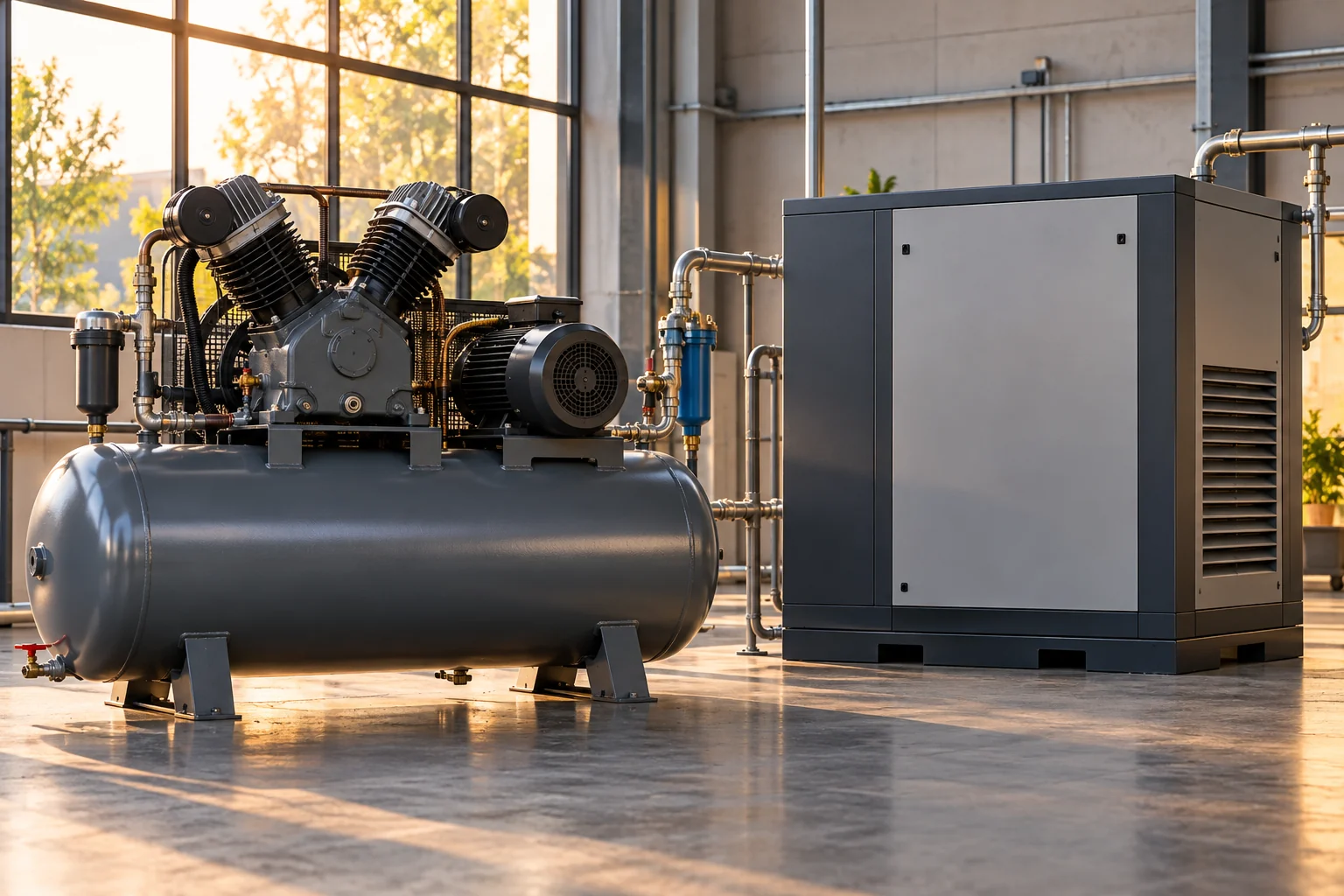
Choose between a rotary screw and piston compressor by the air your work actually needs: required flow at the working pressure, how demand changes through the day, the specific machine's duty rating and required air quality. Piston machines are often considered for intermittent use; rotary screw systems are often considered for sustained demand. Those are starting points, not rules that override a model's specifications.
A bigger motor or a lower purchase price does not settle the decision. Ask a qualified compressed-air specialist to evaluate the application and quote the complete system rather than selecting a compressor by horsepower alone.
Describe the shift, not just the tools
Make a demand sheet showing each air-consuming process, its manufacturer's requirements and when it runs. Note which uses overlap, which are brief and which continue for long periods. Include any production changes you already have a credible plan to make; do not size the purchase around vague future growth.
Atlas Copco's comparison emphasizes operating profile and lifecycle cost alongside the choice of compressor technology. Its guidance describes intermittent and continuous-use tendencies, but also tells buyers to use the actual model's duty specifications. Source: Atlas Copco's piston and screw comparison.
A specialist can use your demand information to assess equipment fit. This article does not supply pressure settings, installation instructions or a universal sizing formula.
Compare evidence, not labels
| Decision | What to request from the supplier |
|---|---|
| Delivered air | Flow at the required pressure, with the measurement basis identified |
| Operating pattern | Suitability for the measured demand and expected working hours |
| Duty rating | The exact model's published limits and required conditions |
| Air quality | Treatment needed for the actual application |
| Controls | How output and power use respond when demand falls |
| Site | Installation, ventilation, electrical and service-space requirements for professional review |
| Support | Maintenance scope, local service and replacement-parts arrangements |
Avoid blanket claims such as “all piston compressors must stop after this many minutes.” Atlas Copco also publishes an industrial piston range with continuous-duty capability, illustrating why the machine specification matters more than the category shorthand. Source: Atlas Copco industrial piston range.
Likewise, do not assume that any rotary screw machine is the economical choice for a workshop with very little demand. Request an estimate based on the proposed unit and actual operating pattern.
Quote the system around the compressor
Ask which parts are included: compressor, receiver where specified, drying and filtration equipment, controls, delivery and commissioning. Obtain qualified installation quotes separately where the supplier does not provide them.
For air used in sensitive processes, have the relevant specialist specify the required quality. A familiar brand name or a general “clean air” description is not proof of suitability for breathing air, food, medical or another controlled use.
Put competing quotes on the same basis. A standalone compressor and a commissioned package with treatment equipment are not equivalent offers even if their motors have the same rating.
Use a transparent operating-cost comparison
Ask suppliers for the assumptions behind any savings claim: demand, run hours, loaded and unloaded power, electricity price, service and installation scope. A percentage without those inputs is not a budget.
Consider a deliberately simplified, invented comparison:
| Five-year cash item | Package A | Package B |
|---|---|---|
| Purchase and installation | $12,000 | $21,000 |
| Assumed annual electricity | $5,000 | $3,400 |
| Assumed annual service | $1,000 | $1,200 |
| Five-year subtotal | $42,000 | $44,000 |
Package A totals $12,000 + 5 × $6,000. Package B totals $21,000 + 5 × $4,600. Under these assumptions, B uses less electricity but still costs $2,000 more over five years. These are not estimates for a particular compressor type, efficiency promises or quotes. They exclude financing, tax, unplanned repairs and other differences.
Change the inputs to actual written estimates. If one package cannot meet the application, it is not a valid comparison regardless of its subtotal. If estimates are uncertain, run more than one reasonable scenario rather than presenting one precise saving as guaranteed.
Match the purchase to the business need
A small occasional-use compressor may be a straightforward cash purchase. Do not add unneeded equipment to create a larger funding request. If you are buying a genuine commercial system, itemize its physical equipment and separate ongoing electricity, service and consumables.
Dengaro's equipment financing requirements can help organize that request. Confirm the particular system, installation lines and supplier with the provider; a package total alone does not establish eligibility.
The right next step is a supplier comparison based on your measured workload. Technology comes second to fit: enough suitable air, the correct support system and costs your business can explain.
Sources
- https://www.atlascopco.com/en-au/compressors/air-compressor-blog/piston-vs-screw-compressor
- https://www.atlascopco.com/content/dam/atlas-copco/compressor-technique/industrial-air/documents/leaflets/air-and-gas-compressors/oil-lubricated-piston-compressors/industrial-/lt-lf-ltb-range%282024%29/LT-LF-LTB__EN.pdf
- https://www.dengaro.com/equipment-financing-requirements