
Self-service car wash equipment cost: a commercial buyer’s budget guide
Separate shared systems, per-bay equipment, installation and site costs when comparing self-service car wash equipment proposals.
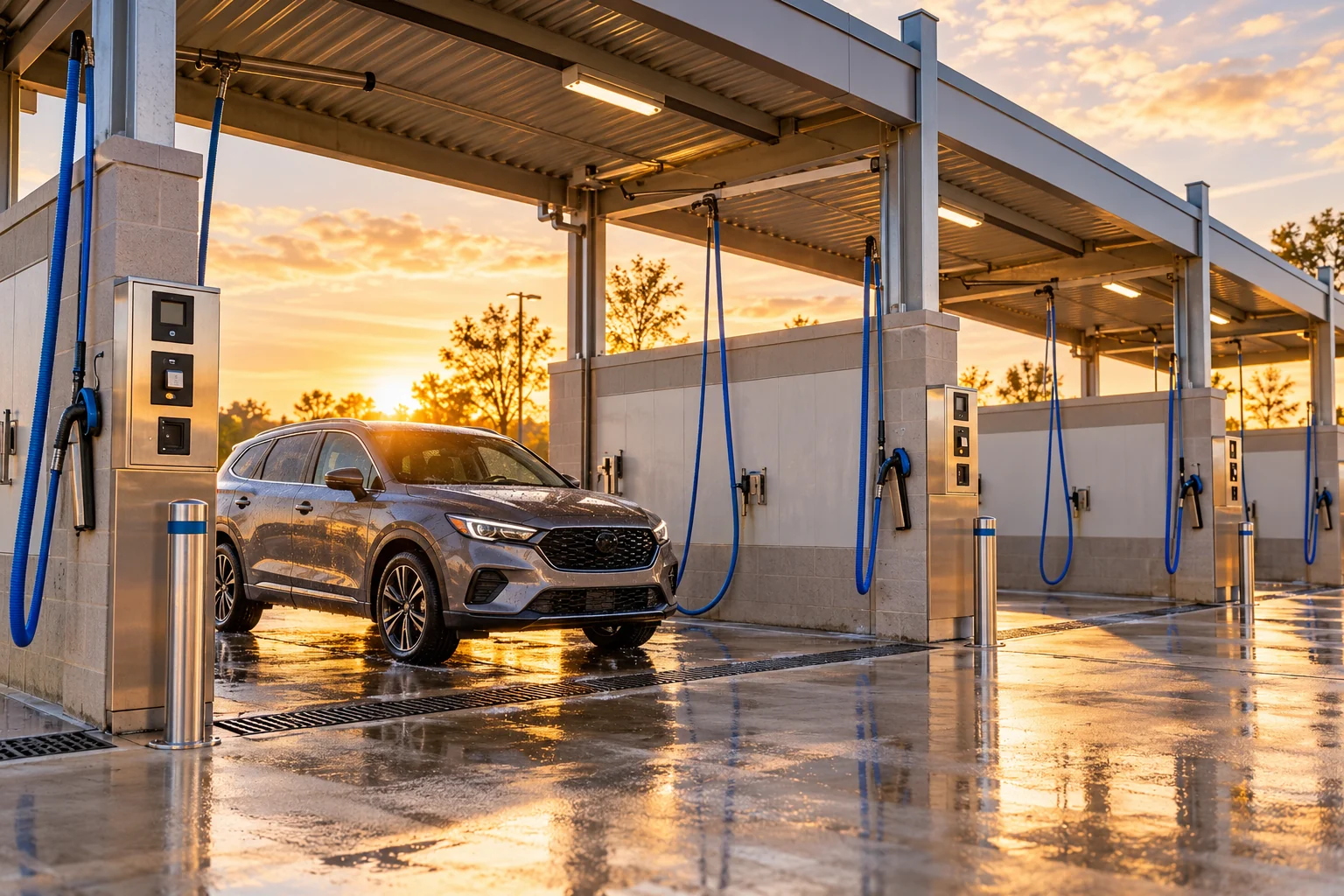
Self-service car wash equipment cost depends on the number of bays, the functions offered and what the site already has. A replacement pump stand for an existing wash is not the same purchase as equipment for a new location. Keep equipment, installation and property development in separate budgets before comparing quotes.
The National Pride self-serve system page reviewed October 30, 2026 describes a pump stand alongside meter boxes, bay hardware and installation packages, with a quote request rather than one public price for every site. That supports a configuration-led budget—not an invented universal cost per bay. National Pride system through Car Wash Superstore
This guide concerns a business purchasing self-service equipment. It does not estimate the total cost of buying land or developing a car wash, and it is not a plumbing, electrical or chemical-handling guide.
Decide whether this is replacement, expansion or a new site
Write the project type at the top of your request. It changes what the supplier needs to inspect and price.
Replacing equipment: Identify the equipment staying in service, the equipment being removed and the compatibility questions that need professional confirmation. Do not assume existing connections or controls can be reused.
Adding bays: Ask which shared systems can support the proposed expansion and which need replacement or additional capacity. Have qualified professionals assess the actual requirements rather than scaling a one-bay price by simple multiplication.
Equipping a new site: Separate the equipment package from building, utility, drainage and other site work. Obtain the necessary professional and authority reviews before treating the project as ready to install.
The supplier should describe the boundary of its proposal. If it sells equipment but does not handle site development, another named party must own that work.
Divide shared equipment from per-bay items
A per-bay total can hide shared costs or count them more than once. Ask the supplier to divide the quote into central equipment, bay equipment and installation.
The cited National Pride page lists pump and control equipment separately from bay hardware such as meter boxes, booms, hoses and customer-facing components. It also describes different options. Use that distinction to request the actual package, without assuming every listed component is included in the price you receive.
| Quote section | What to ask |
|---|---|
| Shared equipment | Which systems serve more than one bay, and what scope is quoted? |
| Each bay | Which payment, control and wash components are included? |
| Customer payment | What hardware, processor arrangements and ongoing charges apply? |
| Supporting systems | Which required items are included, optional or excluded? |
| Installation | Who connects, commissions and hands over the system? |
| Site work | What must qualified contractors complete separately? |
| Training and service | Who supports the equipment after handover? |
Ask for exact quantities. “Four-bay package” is less useful than an inventory showing which items are supplied four times and which serve the whole installation.
Avoid multiplying an incomplete bay price
Here is an entirely hypothetical example, not a supplier quote or market estimate:
| Assumed cost | Amount |
|---|---|
| Shared equipment package | $40,000 |
| Four bay packages at $12,000 each | $48,000 |
| Quoted installation and commissioning | $15,000 |
| Equipment-and-installation subtotal | $103,000 |
Dividing $103,000 by four produces $25,750 per bay for this invented scope. It does not mean a fifth bay costs $25,750, or that the same package fits a different site. Shared capacity and installation requirements would need to be checked again.
Land, building work, utility changes, taxes, financing charges and operating reserves are outside the example. Keep every exclusion visible so an equipment subtotal is not mistaken for an opening-day project budget.
Get site requirements priced before committing
Have the supplier provide the requirements for the specific configuration. Qualified contractors and the relevant authorities should determine what is needed at the actual property, including utility, drainage and environmental matters.
This article does not establish compliance or tell you how to install those systems. The purchasing task is to obtain the scope, responsible party, written cost and completion sequence.
Ask what must be finished before equipment arrives. Who pays if delivery occurs before the site is ready? Where will equipment be stored? What conditions must be met before commissioning and final acceptance?
An equipment supplier's delivery date is not a commitment that unrelated contractors or utility providers will finish at the same time.
Review payment-system costs separately
For the proposed payment setup, ask the seller or processor to identify hardware, installation, transaction charges, connectivity and recurring services. Confirm who owns the account, who provides support and what happens if you change providers.
Do not assume a meter-box price includes every payment option your customers expect. Equally, do not assume a monthly service fee is part of an equipment-financing agreement. Put upfront and recurring costs in different columns.
Use your own forecast to assess payment mix and sales. Do not turn a supplier's potential revenue example into guaranteed demand for your location.
Plan replacement downtime and handover
If the wash already operates, ask how the project affects bay availability. Identify which equipment must be removed, the expected work sequence and who coordinates the contractors. Treat any downtime allowance as an assumption until the responsible parties agree to the plan.
Define acceptance with the supplier and qualified service team: which functions must be demonstrated, what documentation is delivered and who receives training. Have the contract address unresolved items before the final payment, with appropriate professional advice.
For used equipment, obtain the actual inventory, condition records and support arrangements. A low pump-stand price does not establish compatibility with existing bays or continuing parts availability.
Keep financing tied to a defined scope
Present the lender with the itemized equipment proposal and separate site costs. Ask which items can be considered, when funds can be released and what cash the business must provide before installation.
Review Dengaro's equipment-financing requirements, but do not assume a car wash equipment request also covers land, construction, environmental work or operating cash. Provider support for the equipment, seller, condition and transaction must be confirmed.
Common budget questions
Is there one reliable equipment cost per bay?
Not without defining the shared systems, functions, installation and site conditions. A per-bay number can be useful for a completed scope, but it should not replace that scope.
Does equipment financing cover a whole new car wash?
Do not assume it does. Equipment and property development are different budget categories. Ask providers about each cost and keep excluded amounts visible.
What should I send for a quote?
The project type, bay count, desired functions, existing-equipment information and site details requested by the supplier. Arrange the professional assessments needed to resolve compatibility and installation requirements.
Buy a defined system, not a per-bay guess
A strong purchasing plan separates shared equipment, bay components, site work and ongoing expenses. Once those are clear, you can start a Dengaro enquiry to explore whether the equipment transaction fits available options. Approval, eligible costs and terms remain subject to provider review.