
Skid steer vs tractor: choosing equipment for your business
Compare skid steer and tractor packages by real tasks, compatible attachments, remaining work and complete ownership budgets.
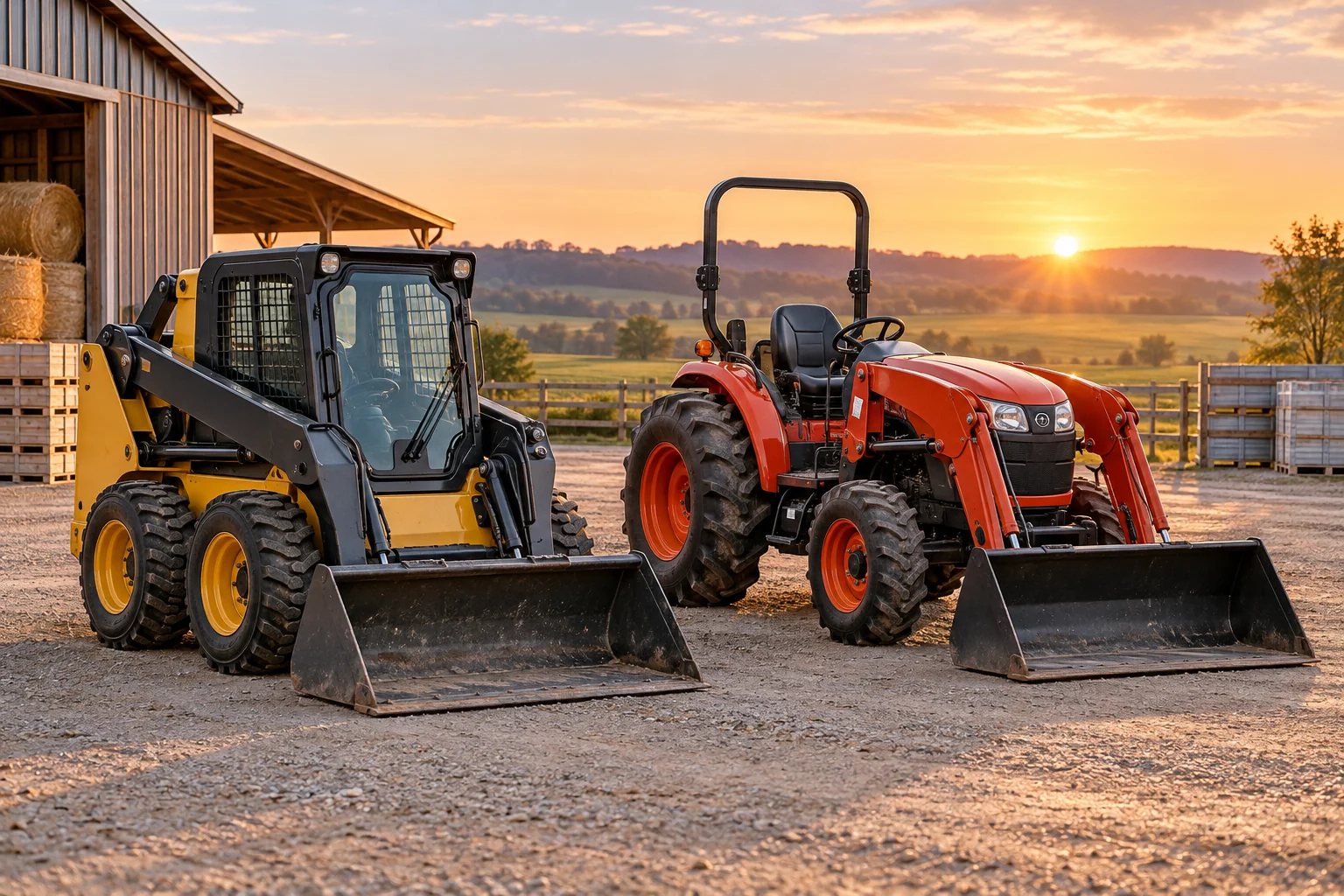
A skid steer versus tractor comparison should start with your weekly work, not a single horsepower number. A business that needs frequent loader and attachment work has a different buying brief from one centered on field implements. Compare the exact machine-and-attachment packages against tasks that generate value for your operation.
Bobcat's regional manufacturer guide distinguishes frequent yard and confined-space loader tasks from tractor work involving PTO-driven implements and field transport. That is a broad way to organize the question, not a guarantee that any model fits your site or existing attachments. Confirm local specifications with an authorized supplier. Bobcat task comparison
This guide concerns commercial purchasing. Qualified personnel must determine machine suitability, attachment compatibility and safe operation. It does not provide loading limits, towing advice or operating procedures.
List the work that actually justifies ownership
Build a task log for a representative month and add any seasonal work separately. Record how often each task occurs, what equipment is currently used and whether the proposed purchase replaces an existing cost or adds a new capability.
A useful brief distinguishes material handling around the yard, attachment-based work, field-implement work and travel between locations. Avoid bundling all of these into a vague request for “the most versatile machine.” Versatility matters only if the quoted configuration can perform the tasks your business needs.
Ask which essential tasks each proposal cannot cover. If one purchase still leaves a substantial rental or contractor requirement, keep that cost visible. Owning one machine does not automatically eliminate the need for other equipment.
Compare attachments as part of the purchase
Kubota's SSV product page presents a skid-steer range with multiple attachment options and separately listed machine specifications. It illustrates why a bare machine price is not the price of every capability shown in its marketing. Kubota SSV range
Request a separate line for each required attachment or implement. Have the supplier confirm compatibility with the exact configuration, including necessary interfaces and any additional equipment. Do not assume that an attachment will work merely because it can appear to connect.
If the business already owns implements, ask for written confirmation that they can be retained with the new machine. A low purchase price can lose its advantage if several existing assets must be replaced.
Use a task-and-package scorecard
| Decision item | What to compare |
|---|---|
| Most frequent task | Supplier-confirmed configuration for the actual workload |
| Existing implements | Documented compatibility rather than assumptions |
| Required attachments | Included items and separately priced purchases |
| Site fit | Qualified assessment of access and working environment |
| Travel and transport | Complete arrangements between work locations |
| Staffing | Familiarity, training and support needs |
| Seasonal demand | Real expected use outside the busiest period |
| Remaining gaps | Work still requiring another machine or contractor |
Have qualified suppliers evaluate representative tasks rather than relying solely on catalog numbers. Compare the same outcome and note any differences in staffing, changeover or supporting equipment.
Do not treat a demonstration on one surface or with one attachment as proof of suitability everywhere. The written purchase brief should define the work that matters to your business.
Compare the whole package, not a bare-machine discount
The following is a fictional budget, not a market price or a recommendation for either machine class.
| Assumed item | Package A | Package B |
|---|---|---|
| Machine | $48,000 | $42,000 |
| Required attachments or implements | $8,000 | $16,000 |
| Delivery and preparation | $2,000 | $2,000 |
| Total | $58,000 | $60,000 |
Package B has the lower machine price but the higher acquisition total. The example deliberately does not assign a machine category to either column; existing equipment and the required work determine the actual comparison.
If a financing proposal covers only the equipment lines, both examples leave $2,000 of delivery and preparation outside that scope. Confirm actual treatment of each cost with the provider rather than assuming all expenses qualify.
Account for the work that remains
Suppose Package A would still require $4,000 a year of outside help for a task it cannot cover, while Package B would require $1,000. That invented $3,000 annual difference belongs in the business case alongside maintenance, energy, labor and ownership costs.
It does not prove that B is better. The quotations may differ in support, capacity or useful life, and your outside-work forecast may be uncertain. The point is to avoid giving either package credit for eliminating work it cannot perform.
Keep nonfinancial requirements visible too. A machine that does not fit the approved site or task is not a viable option simply because a spreadsheet gives it a lower total.
Check whether buying or renting the secondary capability fits better
If one job type occurs only a few times a year, obtain a rental or contractor quote for it. Compare that option with buying the additional attachment or a larger machine configuration.
Use a realistic calendar. A fictional $9,000 annual fixed-cost allocation is $30 per hour at 300 hours or $60 at 150 hours, before variable expenses. This is not a rate estimate; it shows how low utilization changes ownership economics.
Do not increase projected hours merely to make the purchase look cheaper. Separate documented use from hoped-for new work and explain which assumption drives the decision.
Inspect used packages as complete purchases
For a used machine, collect its serial number, configuration, service history and qualified condition assessment. Record which attachments are included and inspect them separately rather than assuming their condition matches the machine's.
Confirm local parts and service support. Price missing accessories, repairs and transport before comparing a used asking price with a new package. An online listing is not proof of stock, condition or suitability.
Questions buyers often ask
Is a skid steer always more versatile?
Only relative to a defined task list and compatible attachment package. A broad attachment catalog does not establish that your quoted machine includes or supports every capability.
Can a tractor with a loader replace a skid steer?
Have qualified suppliers assess the actual work and site. The presence of a loader does not make two configurations equivalent.
Should horsepower decide the purchase?
No single specification answers the whole buying question. Compare the supplier-confirmed package against your required tasks, supporting equipment and total costs.
Finance the work-ready package
After you have a defined quotation, review Dengaro's equipment-financing requirements. If you start an enquiry, list the machine and genuine required attachments separately. Asset eligibility, approval and terms remain subject to provider review.