
Swiss lathe vs CNC lathe: choosing equipment for your business
Compare Swiss-type and conventional CNC turning proposals by finished-part scope, tooling, order volume and installed purchase costs.
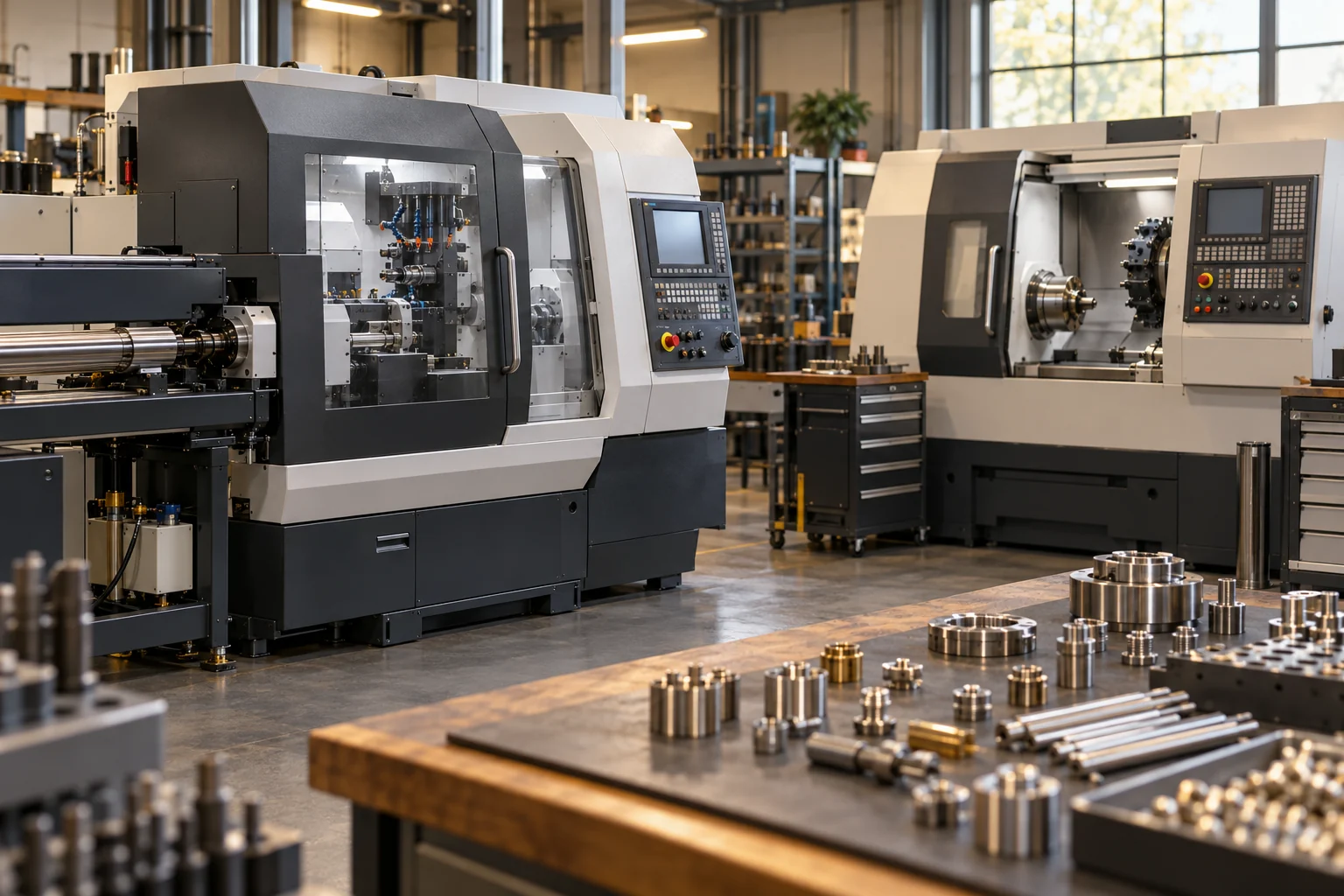
A Swiss lathe can itself be a CNC lathe. The useful buying comparison is therefore a Swiss-type turning machine versus the specific conventional CNC turning center your shop is considering—not computer control versus a different technology. Start with the parts, stock and completed operations each proposed machine must handle.
Neither label tells you the cost of a finished, accepted part. A machine that looks more capable on a brochure can still be the wrong purchase if your orders do not use its capabilities or your quotation leaves out the tooling needed to demonstrate them.
This guide is a purchasing framework, not machining instructions. Have qualified manufacturing specialists assess process suitability, guarding, installation and acceptance requirements.
Compare configurations rather than broad labels
Star's SP-20 product page describes a Swiss-type automatic lathe with a CNC controller, powered tooling and guide-bushing/non-guide-bushing conversion. It also separates standard tooling from optional holders and units. That is a useful reminder that the precise configuration matters more than a category name. The page was reviewed on October 30, 2026. Star SP-20
Do not read this as a recommendation for that model or a claim that every Swiss machine offers the same options. Ask both suppliers to document the proposed workholding arrangement, stock limits, tooling, automation and finished-part handling for your actual job family.
A conventional turning-center proposal should receive the same scrutiny. Ask what it completes in one setup, what moves elsewhere in the shop and what remains a manual task. A feature mentioned during a sales meeting should appear in the written machine configuration before it enters your business case.
Build the comparison around three real jobs
Choose a repeat order, a changeover-heavy order and a likely future order. Keep speculative work separate from purchase justification. For each, provide the supplier with the information your engineering team approves for quotation.
| Question | Evidence to request for both proposals |
|---|---|
| Part and stock fit | Written review against the actual drawing and material |
| Workholding | Included equipment and any part-specific purchases |
| Operations completed | Demonstrated scope, including remaining outside work |
| Tooling | Required holders, tools and optional units priced separately |
| Changeover | What changes between the chosen job families |
| Inspection | How your team will verify the agreed acceptance criteria |
| Automation | Included feeder, loading and part-handling scope |
| Staffing | Skills, training and support needed for this configuration |
Keep a separate list of reasons a job is unsuitable. Rejecting an attractive machine for one essential order is better than discovering the mismatch after delivery.
If the demonstration uses different stock, tooling or a specialist operator, document that difference. You are buying a repeatable capability for your business, not the fastest isolated demonstration a vendor can perform.
Measure the completed route, not only cutting time
Ask for the time and cost to deliver accepted parts through the full proposed route. Include setup, changeovers, required secondary work and inspection in the comparison. Do not assume that a shorter machine cycle automatically frees the same amount of paid labor.
For example, suppose one quotation shows a faster first operation but requires a separate finishing step. The other completes more operations on one machine. Your purchasing worksheet should record the remaining equipment and labor for each route rather than declare a winner from the first-operation cycle alone.
This does not mean every operation should be consolidated. A flexible shop may deliberately keep some work on existing equipment. The question is whether the proposed route fits the order mix and available capacity you actually have.
Compare cost at more than one order volume
Consider a fictional quote comparison. These figures are invented solely to explain the decision, not estimates of Swiss or conventional lathe prices.
- Route A has $6,000 of job-specific setup and preparation costs, then $3 per accepted part.
- Route B has $2,000 of job-specific setup and preparation costs, then $5 per accepted part.
At 1,000 accepted parts, A totals $9,000 and B totals $7,000. At 3,000, A totals $15,000 and B totals $17,000. They are equal at 2,000 parts, where each totals $12,000.
That is a break-even point for these invented assumptions only. It is not a production threshold for either machine class. Machine acquisition, financing, capacity constraints and other costs would need their own treatment; do not count them twice if they are already allocated in a quoted rate.
Run the calculation with the supplier's documented assumptions and your own order forecast. A high-volume case that depends entirely on unsigned work deserves a separate risk label.
Price the installed package
A base machine quotation is not necessarily the amount required to put the proposed production route in place. Request a line-by-line package covering machine configuration, essential tooling, workholding, automation, freight, rigging, installation, training and acceptance support.
For a second fictional example, a $140,000 machine, $24,000 tooling and workholding package, $18,000 feeder and $8,000 delivery and setup allowance total $190,000. If a finance proposal covers only $182,000, the remaining $8,000 requires another funding source. These are not market prices or an eligibility statement.
Ask the supplier which costs recur and which are one-time purchases. Obtain written confirmation of service coverage, replacement-part availability and the process for resolving a failed acceptance test.
Used machines need configuration evidence
For a used candidate, collect its serial number, exact configuration, included accessories, service history and an independent condition assessment. A listing's model name is not proof that optional equipment remains installed or functional.
Have the manufacturer or qualified service provider confirm the support available for that particular machine. Clarify software and documentation transfer, relocation responsibilities and what the seller will demonstrate before payment. Do not assume a used purchase carries the support package quoted with a new machine.
Questions to settle before ordering
Is a Swiss lathe always the better choice for small parts?
No category label establishes suitability for your specific parts. Have suppliers demonstrate the agreed work with the exact configuration being quoted, then compare the complete production route.
Should I pay for options I may need later?
Price the current requirement and the future option separately. Ask whether an option can be added later and what that would involve. Avoid making uncertain future orders carry today's payment obligation.
Can either configuration be financed?
A provider must review the machine, seller, condition, transaction and business. General equipment-financing information does not prove approval for a particular machine or package.
Turn the winning configuration into an itemized request
Once the purchase scope is settled, review Dengaro's equipment-financing requirements. If you start an enquiry, identify the machine and essential accessories separately and ask which costs can be considered. Terms and eligibility remain subject to provider review.