
Telehandler vs forklift: choosing equipment for your business
The useful difference between a telehandler and a conventional vertical-mast forklift is how the load must be placed.
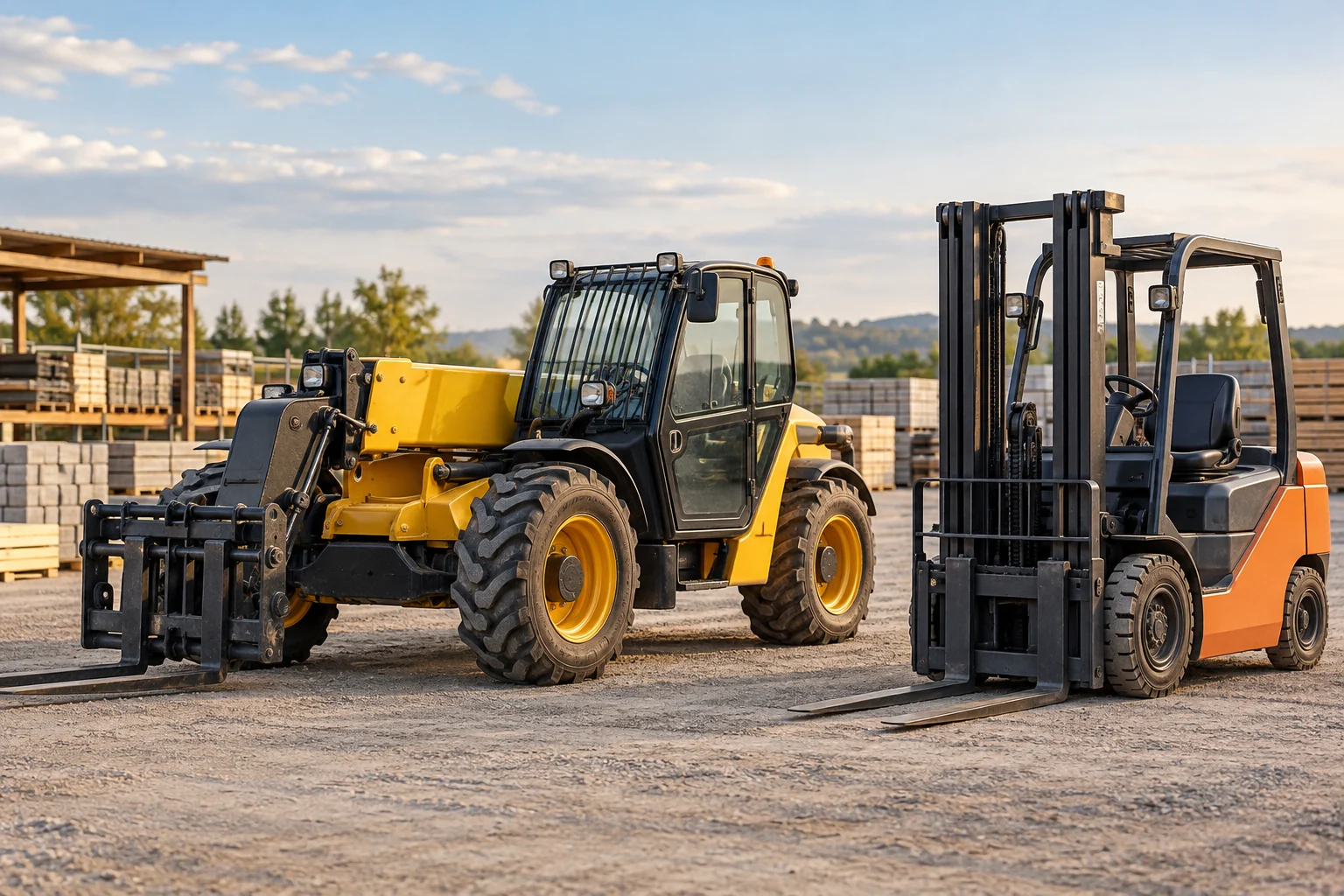
The useful difference between a telehandler and a conventional vertical-mast forklift is how the load must be placed. A telehandler has a telescoping boom that reaches outward as well as upward. A vertical-mast forklift primarily raises loads along its mast. Choose the exact machine around the job and site—not just a headline lifting-capacity number.
This is a purchasing comparison for businesses. It does not determine safe capacity, approve a lift plan or provide operating instructions. A qualified supplier and the responsible site professionals must assess the actual machine, attachment and task.
First, clarify what the seller means by forklift
“Forklift” is a broad label, and a telehandler can also be described within a broader forklift classification. For a buying comparison, specify whether you mean a warehouse counterbalance truck, a rough-terrain vertical-mast machine or another type.
JLG's explanation distinguishes telehandlers from vertical-mast rough-terrain forklifts by the telescoping boom's ability to reach out and over an obstacle. It also notes that capacities and lift heights vary across machines. That is a useful high-level distinction, not proof that two particular units are interchangeable. JLG telehandler and forklift comparison.
Avoid turning a category comparison into a claim that all forklifts belong indoors or that all telehandlers fit every construction site. The exact configuration and approved use matter.
Describe the material movement before shopping
Write down the start and end of the task. Is the business moving pallets between nearby storage positions, unloading deliveries or placing material beyond a simple vertical lift location? Have the supplier use that description to recommend equipment.
| Procurement question | What the answer helps establish |
|---|---|
| Where does material start and finish? | Whether carrying, vertical placement or outward reach defines the task |
| What is the site environment? | Which equipment configurations need professional assessment |
| What access and space constraints exist? | Whether a proposed machine can be considered for the location |
| Which attachments are required? | The exact compatible package to quote |
| How often is the task repeated? | Whether ownership matches the business workload |
| How does the machine move between sites? | Delivery and recurring transport costs |
Do not use this table to calculate a load limit or improvise a lifting arrangement. The supplier and qualified personnel should use the manufacturer's documentation for the actual configuration.
Compare complete configurations—not nominal capacity
A headline capacity number does not describe every placement situation. Ask the supplier to confirm the proposed machine and attachment against the intended work, and retain the relevant documentation in the purchase file.
For a telehandler, the commercial quote should identify the exact boom configuration, included attachment and any required options. For a vertical-mast forklift, identify the mast and attachment configuration, power system and other relevant options. Do not assume that two units with the same broad model family have identical capabilities.
Keep the technical suitability review separate from the price negotiation. A seller reducing the price does not resolve a mismatch between the equipment and the job.
If your work needs two different capabilities, compare a mixed plan—owning one machine and renting another when genuinely needed—rather than forcing one purchase to cover every task.
Build the cost comparison around the actual package
Here is a fictional comparison, not a market-price range or a recommendation that the machines are substitutes:
| Cost line | Proposed package A | Proposed package B |
|---|---|---|
| Machine | $45,000 | $70,000 |
| Required compatible attachment | $3,000 | $5,000 |
| Delivery | $2,000 | $3,000 |
| Initial inspection and agreed work | $2,000 | $2,000 |
| Project subtotal | $52,000 | $80,000 |
Package B requires $28,000 more upfront in this invented example. Whether that difference makes sense depends on a real capability the business needs and work that supports it. It is not justified simply because the machine appears more versatile.
The subtotals exclude taxes, financing charges, ongoing service, fuel or charging costs, storage and operator labor. Include the relevant costs in your own ownership forecast without assuming any category has a universal advantage.
Identify the work that would otherwise be rented
Suppose the more expensive package is being considered because of a recurring placement task. List the actual jobs, the current rental or subcontracting cost and the transport involved. Separate confirmed work from hoped-for expansion.
Then ask whether buying would really eliminate that expense. Some work may still need another machine or specialist service. Do not count the full rental budget as a saving if only part of it changes.
Keep productivity claims cautious. A demonstration can help your team evaluate suitability, but it does not guarantee a specific increase in revenue. Have the people responsible for operations and finance agree on the assumptions used in the purchase case.
Look beyond the hour meter on used equipment
Request serial numbers, service records, seller disclosures and a qualified condition assessment. Reported hours are context, not a verdict on remaining life or suitability.
Have the exact attachments included in writing. Ask about software or electronic-system support where relevant, warranty terms and local service availability. If the seller promises repairs before delivery, identify the work and acceptance terms in the agreement.
This guide does not provide inspection, maintenance or repair procedures. A buyer should use qualified professionals rather than treating a price comparison as technical approval.
Also resolve transport before paying a deposit. Give the actual equipment configuration to the qualified transport provider; do not rely on a generic category weight or dimensions.
Compare financing only after choosing a suitable package
Request proposals for the same defined purchase. Record the amount funded, excluded costs, upfront cash, payment term, fees and end-of-term obligations. A lower payment can reflect a longer commitment or a different ownership outcome.
Ask the provider whether it supports the equipment, seller and used condition. Do not assume that approval for one type of material-handling equipment automatically covers another or that all attachments receive the same treatment.
Keep a cash plan for costs outside the proposal. Delivery, inspections and initial work may require separate funds even when the machine is eligible.
Common questions
Is a telehandler simply a bigger forklift?
No. The telescoping-boom placement capability is a meaningful distinction from a vertical-mast machine. Compare the actual task and configuration rather than describing the difference only by size.
Can I compare two machines using their stated capacity alone?
No. Have qualified personnel evaluate the actual configuration and intended placement using manufacturer information. A single headline figure is not a complete suitability assessment.
Should I buy a telehandler for occasional reach work?
Not automatically. Compare ownership with renting or subcontracting that defined task, while retaining the equipment suited to recurring work.
Take the selected machine to the next step
Once the supplier-supported configuration and quote are clear, review Dengaro's equipment financing requirements. Confirm asset and seller support before proceeding. Approval and terms remain subject to provider review, separate from the professional assessment of the worksite and equipment.