
Thermoforming vs injection molding: choosing equipment for your business
Compare thermoforming and injection molding by finished-part requirements, tooling, accepted output and the full cost of bringing production in-house.
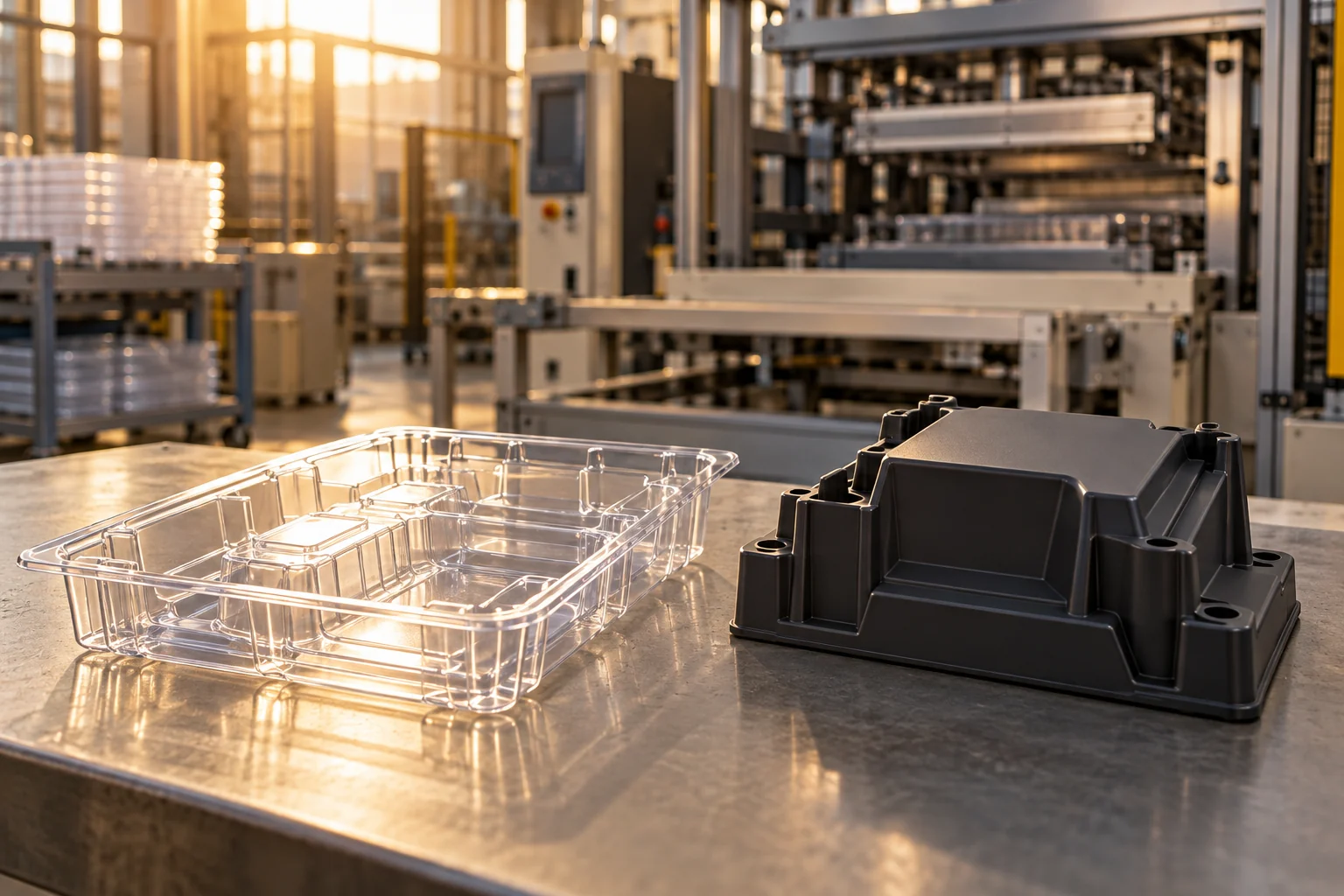
Compare thermoforming and injection molding around the finished part your customers need—not a universal production-volume cutoff. Start with geometry, material, quality requirements, expected orders and the work needed after forming. Then compare tooling, equipment, secondary operations and cost per accepted part. A cheaper tool does not automatically make the complete production route cheaper.
For a business considering equipment ownership, there are really two decisions: which process can make the part acceptably, and whether bringing that process in-house makes more sense than buying finished parts. Do not let an attractive machine quote collapse those into one decision.
Define the part before choosing the machine
Have a qualified manufacturing specialist review the design and material requirements. Give competing suppliers the same drawing revision, expected quantities and acceptance requirements. Ask them to identify any design changes their process needs.
Formech describes vacuum forming as heating a plastic sheet and forming it over a mold using vacuum. It notes that trimming may be needed after forming and that tooling cost, complexity, finish and quantity affect process choice. Vacuum forming is one thermoforming approach, not a description of every thermoforming system. Source: Formech's process overview.
Protolabs describes injection molding services for both prototype and production needs, with different tooling and quality-documentation options. That is a useful counterpoint to the claim that injection molding only becomes relevant at one fixed high volume. Supplier capabilities and the part matter. Source: Protolabs injection molding services.
Those sources explain process considerations, not guaranteed economics for your design. Obtain a part-specific assessment.
Ask for the same finished result
A formed blank and a finished, inspected component are not equivalent deliverables. List every step needed to reach the part your customer accepts.
| Comparison question | What the proposal should identify |
|---|---|
| Design fit | Required changes, critical features and material assumptions |
| Tooling | Tool scope, ownership, maintenance and replacement arrangements |
| Secondary work | Trimming, machining, joining, finishing or assembly included |
| Quality | Inspection method, sample approval and acceptance criteria |
| Output | Accepted parts expected under stated production assumptions |
| Changeovers | Work and time needed between product variants |
| Waste and rework | How estimates account for rejected parts and scrap handling |
Do not use machine cycles as a substitute for accepted production output. Ask what happens after each cycle and whether the supplier's estimate includes that work.
A tooling comparison needs a volume scenario
The following figures are entirely hypothetical. They are not equipment prices, industry averages or a recommendation for a particular process.
Assume two qualified suppliers have shown that their proposed routes can meet the same finished-part requirements:
| Cost assumption | Route A | Route B |
|---|---|---|
| Initial tooling | $12,000 | $42,000 |
| Cost per accepted finished part | $18 | $10 |
| Total at 2,000 accepted parts | $48,000 | $62,000 |
| Total at 6,000 accepted parts | $120,000 | $102,000 |
At 2,000 parts, A is $14,000 lower. At 6,000, B is $18,000 lower. Under these fixed assumptions, the $30,000 tooling difference divided by the $8 unit-cost difference gives 3,750 accepted parts as the mathematical crossover.
That is not a thermoforming-versus-injection-molding rule. The example deliberately uses route labels because real quotes may behave differently. Tool changes, multiple cavities, different material costs, quality losses and order sizes can change the comparison. A forecast of 6,000 units is also not the same as 6,000 committed orders.
Run a lower-demand case and a design-change case. If the design may change after the first run, ask both suppliers what changes would cost and what tooling could be reused. Do not assume either process makes revisions free or simple.
Separate outsourced parts from owning a production line
A per-part supplier quote includes a business doing work for you. A machine quote is not a substitute for that complete service. For an in-house project, ask qualified specialists to define the full production system:
- Main equipment and compatible tooling.
- Material preparation and handling equipment required by the process.
- Secondary operations and inspection equipment.
- Utilities, installation and commissioning requirements.
- Staffing, training, maintenance and support.
- Space and workflow needed for the intended output.
This is a purchasing scope, not a guide to operating industrial equipment. Safety, installation and process design need qualified review and manufacturer instructions.
Price the actual line instead of adding a rough machine payment to the outsourced piece price. Keep initial equipment expenditure, recurring production costs and working capital separate. Confirm which costs are vendor invoices and which are internal estimates.
Turn a process choice into a credible purchase request
Before seeking equipment financing, save the approved part scope, supplier feasibility findings, itemized equipment quote and the demand assumptions behind the purchase. Mark unresolved questions rather than hiding them in an optimistic output forecast.
Dengaro's equipment financing requirements can help organize a genuine commercial equipment request. Confirm whether the particular machinery, tooling, supplier and related charges are supported. No part forecast, package value or process choice establishes approval.
The strongest decision is not “thermoforming is cheaper” or “injection molding scales better.” It is a documented answer to a narrower question: which qualified production route delivers this part, at this quality and demand, with costs the business can support?