
Financing commercial trailers and equipment-hauling packages
Organize commercial trailer financing around the real trailer, equipment invoices, business use and complete cash obligations.
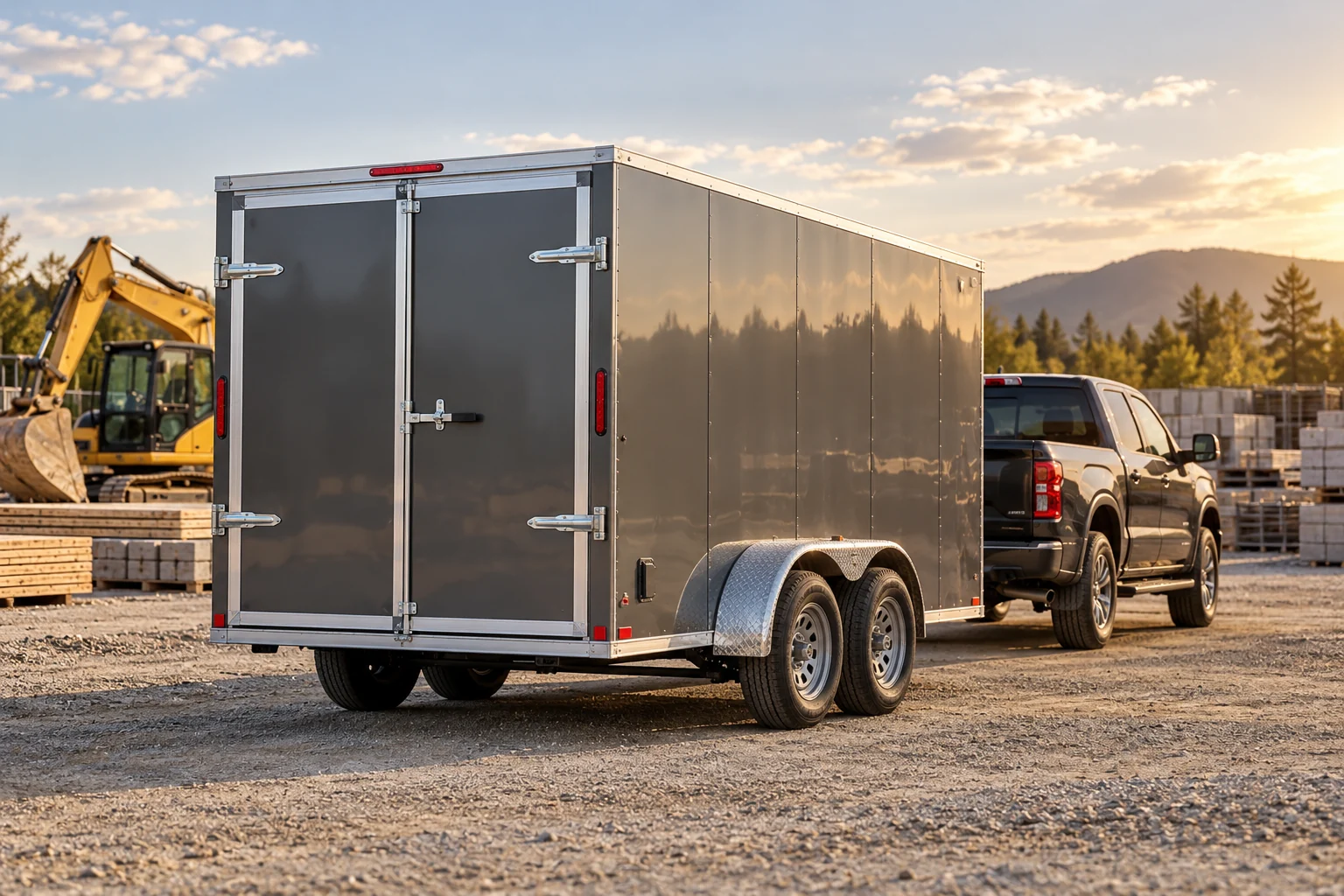
For commercial enclosed trailer financing, define the actual trailer and any genuine equipment package before requesting terms. Identify the trailer separately from the tools or machines it carries, and ask which assets and costs the proposed provider supports. A consumer trailer offer or a low advertised payment may not describe the same business transaction.
This guide concerns real commercial purchases, not recreational trailers or adding unnecessary items to reach a financing threshold. A small standalone trailer may require a different route from a larger equipment-hauling package.
Separate the trailer from the cargo it will carry
Prepare two inventories: what is being purchased, and what the business already owns. The trailer quote should identify the model, configuration, seller and included accessories. Any newly purchased equipment should have its own description and price.
If the business already owns the machines being hauled, do not include their value as a new purchase. If equipment and trailer are sold by different vendors, explain that arrangement instead of assuming one lender can pay both invoices under the same process.
Use this scope sheet:
| Part of the request | What to document |
|---|---|
| Trailer | Exact model, VIN or serial information where available, configuration and condition |
| Included accessories | Itemized racks, storage or other quoted additions |
| Newly purchased equipment | Separate models, identifiers and prices |
| Existing equipment | Identify for compatibility planning, but not as new purchase cost |
| Delivery and setup | What the supplier provides and what the buyer must arrange |
A clear package makes the provider's inclusion and exclusion decisions easier to understand.
Confirm physical fit before financial fit
Have qualified trailer and vehicle specialists assess the intended load, loading method and tow arrangement. Ask them to confirm the actual configuration, not merely the trailer's advertised length.
An enclosed trailer's door opening, interior arrangement and installed accessories may matter as much as the outside dimensions. Record the requirements for the actual business equipment and have the supplier explain how the proposed unit meets them.
This article provides no loading limits, towing calculations, tie-down instructions or legal conclusions. A financing approval cannot establish that a trailer, vehicle and load are a safe or permitted combination.
Do not solve a fit problem by assuming a modification can be added later at little cost. Obtain the appropriate professional assessment and written quote before the purchase is treated as complete.
Check whether the offered product matches the business purchase
Trailer financing exists through different providers and dealer relationships. Sheffield Financial, for example, has a Big Tex financing page and explicitly states that loans are subject to credit approval. That establishes a named manufacturer's financing route, not eligibility for every brand, used unit or business package. Sheffield's Big Tex financing information.
Ask prospective providers about:
- The trailer's actual commercial use.
- New versus used condition and seller type.
- Whether multiple pieces or invoices can be considered together.
- Which delivery, accessory or other costs are eligible.
- Required documents and conditions before funding.
Do not assume a program presented to an individual buyer has the same terms for a business. Equally, do not assume a business-equipment provider accepts every trailer purchase. Confirm the actual transaction before relying on an estimate.
Itemize the amount requested
Here is an invented commercial package, not a supplier quote:
| Assumed item | Amount |
|---|---|
| Enclosed trailer | $18,000 |
| Genuine newly purchased business equipment | $22,000 |
| Quoted trailer storage/accessories | $3,000 |
| Delivery | $1,000 |
| Purchase subtotal before other costs | $44,000 |
If a provider accepted the trailer and new equipment but excluded accessories and delivery, it would consider $40,000 of this illustration, leaving $4,000 outside that scope before any required contribution or other charges.
That is an example of documenting inclusions, not a suggestion to bundle unrelated or unnecessary goods. Replace every line with a real purchase quote. Ask the provider how it handles separate vendors and which evidence of delivery or acceptance it requires.
For used assets, keep identity and condition records attached to each item rather than describing the whole package as “equipment.” Have qualified people address title, ownership or lien questions where relevant; do not infer clear ownership from an invoice alone.
Compare payments through the same outcome
Two proposals can use different payment schedules and end conditions. Ask for the amount financed, cash due, payment count, fees and any final purchase amount in writing.
For a fictional ownership comparison, $4,000 upfront plus 36 payments of $1,250 totals $49,000. A second structure with $1,000 upfront, 36 payments of $1,100 and a fixed $10,000 final purchase amount totals $50,600. The lower regular payment produces a $1,600 higher illustrated total.
These are invented figures, not offers or APR calculations. If a final amount is not fixed, show that uncertainty rather than using zero. Seek qualified advice on contractual, tax and accounting questions.
Keep operating needs outside the purchase subtotal
Insurance, vehicle operating costs, staffing and other business expenses still need their own cash plan. Buying an equipment-hauling package does not guarantee customer work or revenue.
For an existing business, explain what the purchase changes: a replacement, a more suitable transport setup or capacity for identified work. Keep hoped-for contracts separate from confirmed work. If a trailer is not yet available, do not promise job capacity based on an unconfirmed delivery date.
Start with Dengaro's equipment financing requirements, then confirm whether the real trailer or multi-piece transaction fits available options. A purchase total alone does not establish eligible costs or approval.
The useful request is specific: these assets, these sellers, this commercial use and these costs. That is more informative than applying for a monthly payment against a generic “trailer package.”