
Tub grinder cost: a commercial buyer’s budget guide
Build a tub grinder budget using dated dealer prices, documented wear work, loading equipment, screens and transport—not a guessed market average.
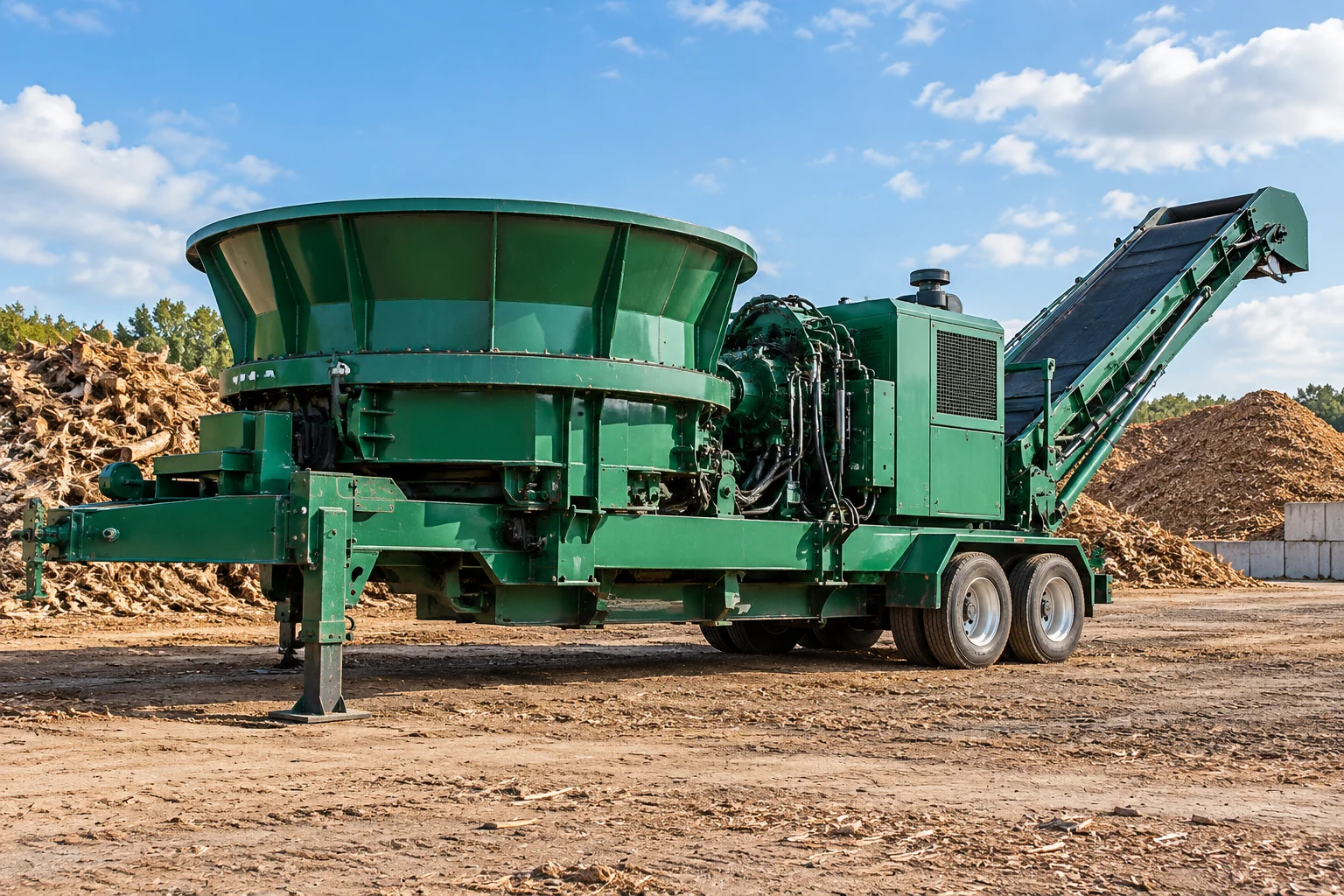
Tub grinder cost depends on the exact machine, its wear condition and what your business must add around it. Separate the grinder’s purchase price from screens and wear parts, loading equipment, transport and any work needed before acceptance. Compare equipment for the same material and output requirement—not simply the lowest advertised horsepower-per-dollar figure.
Two dealer listings reviewed October 30, 2026 provide concrete, limited examples: GrinderCrusherScreen advertised a 2007 Morbark 1300 with 8,312 recorded hours for $210,000 and a 2021 Vermeer TG5000 with 2,095 recorded hours for $495,000. These are different machines and asking prices, not a representative market range or proof of current availability. (Morbark listing, Vermeer listing.)
Define the material and finished-product requirement
Before pricing a grinder, write down what enters your operation and what must leave it. A contractor reducing irregular wood waste has a different purchasing question from a yard selling a specified finished product. Do not assume a seller’s broad production claim describes your material, preparation or quality target.
Give the supplier a purchasing brief covering:
- The material categories your qualified team intends to process.
- The required output specification and who defines acceptance.
- Expected working periods and seasonal demand.
- Loading equipment already available.
- Whether the grinder remains at one location or moves between jobs.
- Any separate screening or handling equipment in the proposed system.
Ask the manufacturer or qualified equipment specialist to confirm suitability. A purchase comparison is not a guide to feeding, inspecting or operating this machinery.
The grinder and the loading arrangement are separate decisions
Vermeer’s TG5000 page identifies an optional loader cab. That is a configuration distinction worth checking: an option shown in product photography is not necessarily installed on a used machine offered for sale. (Vermeer TG5000.)
Record whether your proposal includes that equipment, assumes a separate loader or relies on an existing machine. If it relies on a machine you already own, check its availability across the same work calendar. An asset cannot cover two simultaneous assignments merely because it appears on the fleet list.
This can change the buying decision more than a small discount. A low-priced grinder that leaves your loading plan unresolved is not yet a complete acquisition proposal.
Make wear condition visible in the quote
For a used grinder, arrange a qualified inspection and ask for separate documentation of the engine, grinding assembly, screens, conveyor and other relevant systems. A rebuilt engine does not establish that the entire machine was rebuilt. Recorded hours also need context: identify which meter or component the seller is describing.
Use a purchase worksheet rather than an undocumented allowance:
| Budget line | Evidence to obtain | Avoid this assumption |
|---|---|---|
| Grinder | Serial-number-specific offer and inspection | “Runs well” means no near-term work |
| Screens and wear items | Included list plus specialist’s assessment | All pictured parts are supplied |
| Conveyor and discharge arrangement | Exact installed configuration | Every advertised option is on the unit |
| Loading equipment | Existing asset availability or separate quote | A loader is automatically included |
| Transport | Written delivery or hauling quote | Towable means free or simple to relocate |
| Seller work | Itemized work, completion date and acceptance record | A verbal promise is already priced |
The goal is not to predict every repair. It is to distinguish known purchase requirements from unresolved condition questions before committing to the transaction.
A price comparison that changes after wear work
Consider two fictional proposals for machines already judged suitable by the buyer’s specialist:
| Item | Machine A | Machine B |
|---|---|---|
| Asking price | $160,000 | $186,000 |
| Documented work required for the buyer’s acceptance | $24,000 | $5,000 |
| Additional quoted screens and wear items | $8,000 | $4,000 |
| Delivery | $7,000 | $5,000 |
| Acquisition subtotal | $199,000 | $200,000 |
The $26,000 headline price gap becomes $1,000 on this limited acquisition worksheet. These invented amounts are not repair estimates or typical grinder costs. Taxes, insurance, operating expenses and any additional loading equipment remain outside the table.
Now compare the uncertainties. Which work has a firm quote? Which parts are available? Does the intended start date depend on an unconfirmed repair? A nearly equal subtotal can still hide a very different readiness risk.
Keep throughput claims out of the repayment assumption
Do not convert an advertised processing rate directly into guaranteed sales or margin. Request evidence relevant to your material and quality requirements, and have your team assess the full handling process. A grinder is one part of that process; receiving material, loading, product handling and customer demand are separate constraints.
For the purchase decision, maintain a conservative operating budget beside the acquisition worksheet. It should not depend on every scheduled hour producing saleable output at the seller’s best-case rate.
Organize the equipment request
Once the machine and supporting items are documented, review Dengaro’s equipment financing requirements. Ask the funding provider whether it will consider the exact equipment, age, seller and separate cost items. Neither these listings nor the worksheet establishes financing availability.
Is the cheapest used tub grinder the lowest-cost choice?
Not necessarily. Known wear work, missing components and the loading arrangement can narrow or reverse the difference. Use actual quotes, not a fixed repair percentage.
Should I budget for a new grinder instead?
Obtain a configured manufacturer or dealer proposal and compare the same complete scope. Two used listings do not establish a new-machine price. The useful next step is a documented comparison, not a guessed market average.